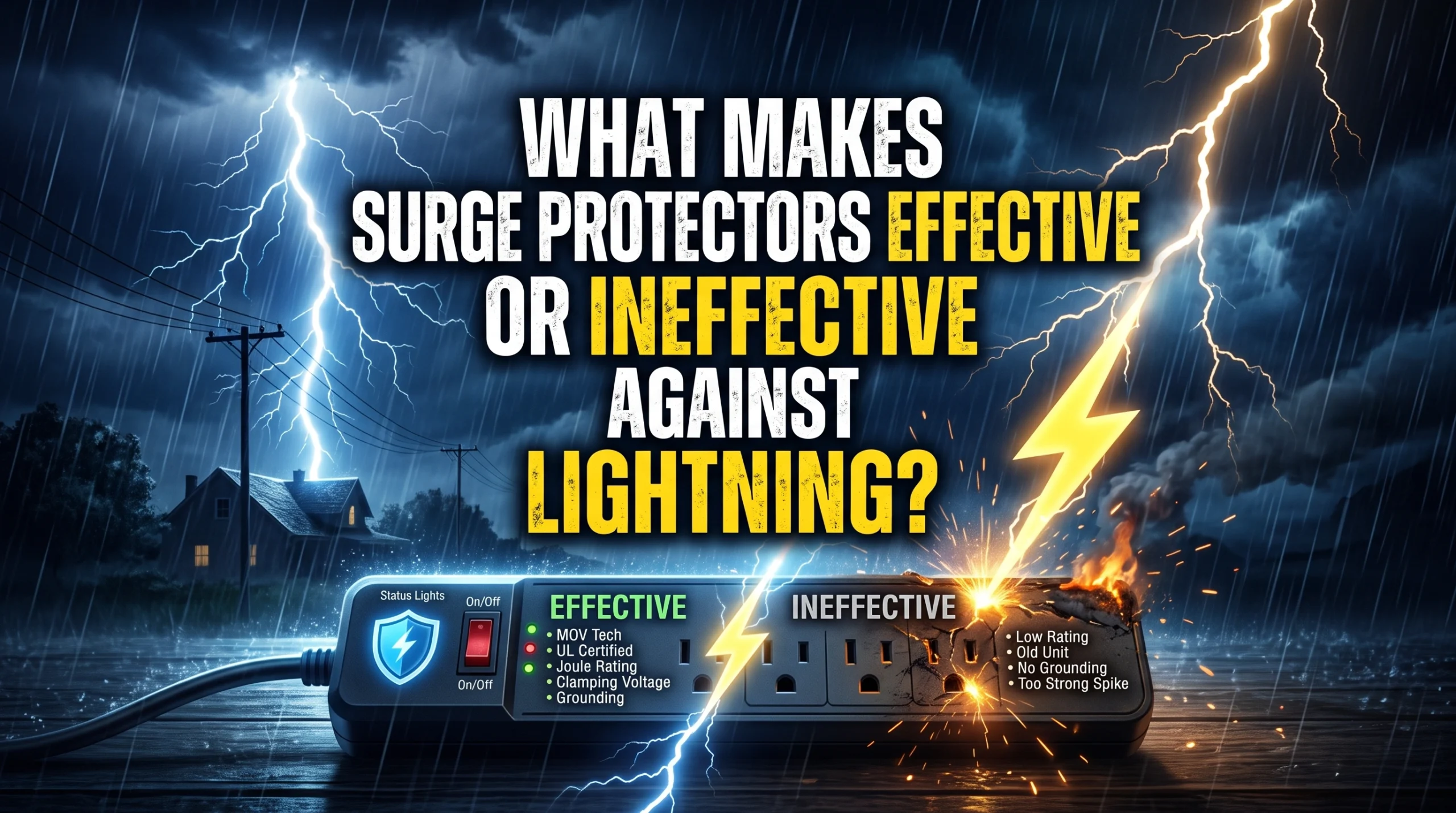
Storms can make anyone nervous when expensive electronics are plugged in. TVs, computers, routers, gaming systems, and appliances can all be damaged by sudden voltage spikes. So it is natural to ask whether a surge protector can really protect your devices from lightning.
The short answer is that surge protectors help, but they are not a complete shield. They can reduce damage from smaller surges and nearby lightning activity, but a direct lightning strike can overwhelm even a good surge protector. That is why real protection depends on knowing the limits of these devices and using a smarter, layered approach.
In this guide, you will learn what makes surge protectors effective against lightning related surges, where they fall short, and why whole home protection, proper grounding, and unplugging devices during severe storms still matter.
Before we explain how surge protectors handle lightning, here are the key takeaways to keep in mind.
Key Takeaways
-
Surge protectors can help protect electronics from smaller power surges but cannot fully shield against direct lightning strikes.
-
For better protection, combine whole-home surge protectors with point-of-use devices to manage both large and small electrical surges.
-
Unplugging devices during storms is the most effective way to prevent damage from lightning-induced surges.
Do Surge Protectors Protect Against Lightning?
When you consider how to protect your electronics from lightning, you might ask, do surge protectors protect against lightning? This question often arises during storm season, especially when you see flashes of lightning and hear thunder nearby. Many homeowners believe that plugging devices into a surge protector will shield them from all types of power surges, including those caused by lightning. However, the reality is more complex.
Understanding what surge protectors protect against, and where their limitations lie, helps you make informed decisions about surge protection and the safety of your valuable equipment.
How Surge Protectors Protect
Surge protectors serve as the first line of defense against power surges. These devices monitor the voltage in your electrical circuit and remain inactive during normal operation. When lightning causes a sudden spike in voltage, surge protectors detect the abnormal condition and respond quickly. Instead of allowing the excess energy to reach your sensitive electronics, the device diverts the surge current to the ground. This process helps prevent damage from smaller surges that can occur during storms or when large appliances cycle on and off.
Inside a surge protector, you will find several key components that respond to voltage spikes. Metal oxide varistors (MOVs) act as variable resistors, changing their resistance based on voltage levels. When a surge occurs, MOVs divert excess energy away from your devices. Other components, such as gas discharge tubes, spark gaps, avalanche diodes, and suppressor diodes, also play a role in limiting voltage spikes by channeling excess current safely to the ground. Surge protectors use these technologies to manage power surges and protect your electronics from most everyday threats.
-
Voltage monitoring keeps your devices safe during normal operation.
-
Surge detection allows the device to respond instantly to abnormal voltage.
-
Surge diversion channels excess energy to the ground, away from your electronics.
-
Key components include:
-
Metal oxide varistors (MOVs)
-
Gas discharge tubes
-
Spark gaps
-
Avalanche diodes
-
Suppressor diodes
-
Limits of Surge Protectors
While surge protectors offer valuable protection against many types of power surges, they have clear limitations when it comes to lightning. You should know that standard surge protectors cannot guarantee protection from direct lightning strikes. A single lightning bolt can deliver up to one billion volts, far exceeding the capacity of any surge protector. Even advanced lightning protection systems struggle to redirect all of this energy safely into the ground. As a result, surge protectors protect against lightning-induced surges only to a certain extent.
Surge protectors can help with smaller surges caused by lightning that strikes nearby power lines or transformers. These indirect surges may travel through your home’s wiring and reach your devices. In these cases, surge protection can reduce the risk of damage. However, if lightning strikes your home directly, the resulting surge will likely overwhelm any surge protector. The immense force of a direct strike can bypass or destroy the device, leaving your electronics vulnerable.
-
Surge protectors cannot fully protect against direct lightning strikes.
-
Power surges from nearby lightning can still damage electronics, even with surge protection.
-
Frequent lightning-induced surges can shorten the lifespan of surge protectors, sometimes reducing their effectiveness after just 2-3 years in storm-prone areas.
-
In stable environments, surge protectors may last 3-5 years or longer, but repeated surges from lightning will degrade their performance more quickly.
Note: Surge protectors provide some defense against everyday power surges, but you should not rely on them as your only line of defense during severe lightning storms.
Lightning Arrestors vs. Surge Protectors
You may wonder how lightning arrestors compare to surge protectors. Both devices aim to protect electrical systems from surges, but they differ in design, function, and application. Lightning arrestors are larger and heavier, often made from silicone rubber, ceramic, or metal cans. These materials provide excellent insulation and allow the device to handle much higher surge currents. You will find lightning arrestors in high voltage environments, such as power stations and railways, where they protect infrastructure from powerful lightning strikes.
Surge protectors, on the other hand, are smaller and designed for low voltage applications. They use materials like silicone, epoxy, plastic, and combinations of metal and ceramic. You typically install surge protectors in server rooms, offices, or homes to protect sensitive electronics from everyday power surges.
|
Device Type |
Typical Location |
Main Function |
Materials Used |
|---|---|---|---|
|
Lightning Arrestor |
Outside home/business |
Redirects high-energy lightning surges to ground |
Silicone rubber, ceramic, metal cans |
|
Surge Protector |
Inside home/office |
Diverts smaller surges from electronics |
Silicone, epoxy, plastic, metal, ceramic |
-
Lightning arrestors protect electrical appliances from outside surges, installed outside the home or business, and redirect electricity flow to the ground directly.
-
Surge arrestors (a type of surge protector) protect appliances inside the home, installed within the main panel board, and divert surplus energy to the ground.
When you ask, do surge protectors protect against lightning, you should remember that only a comprehensive lightning protection system, which may include both surge protectors and lightning arrestors, can offer layered defense. Surge protection alone cannot guarantee safety from all lightning surges or direct strikes. Understanding the differences between these devices helps you choose the right solution for your home or business.
Making Surge Protection More Effective
Key Features for Better Protection
When you want the best protection against power surges, you need to look for specific features in your surge protection devices. Not all power strip surge protectors offer the same level of defense against electrical surges or voltage spikes. The table below highlights what to look for:
|
Feature |
Description |
|---|---|
|
Meets strict safety standards for whole house surge protectors. |
|
|
Peak Surge Current Rating |
39,000 amperes or higher for handling dangerous power surges. |
|
Let-Through Voltage |
330 volts or less for better performance against voltage spikes. |
|
Joule Rating |
420 joules or more for greater protection from electrical surges. |
|
Indicators |
Status lights or alarms show if the device still works. |
|
Warranties |
At least 5 years for whole-home surge protectors. |
|
Noise Attenuation |
Reduces interference from electrical surges caused by lightning. |
|
Response Time |
Fast reaction to voltage spikes keeps electronics safe. |
Layered Surge Protection Strategies
You get the most reliable defense when you combine whole-home surge protectors with point-of-use power strip surge protectors. Installing a whole-home surge protector at your main electrical panel shields your entire house from large external electrical surges, especially those from lightning. Power strip surge protectors add another layer, guarding sensitive devices from smaller voltage spikes inside your home. This layered approach ensures that both major and minor electrical surges are managed effectively.
-
Whole-house surge protectors: Installed at the panel, protect all circuits from external electrical surges.
-
Power strip surge protectors: Add extra protection for individual electronics.
-
Unplugging devices: Offers the highest level of safety during severe storms.
Practical Tips to Protect Against Lightning
To protect against lightning, you should take several practical steps beyond just using whole house surge protectors. Unplug electronics during storms to avoid electrical surges. Maintain your electrical system and ensure proper grounding for your home. When installing a whole-home surge protector, always check for certifications like UL, ETL, or CE. After a lightning event, test your surge protection using methods such as watt loss tests or checking indicator lights. These actions help you keep your surge protection effective and your electronics safe from voltage spikes.
You now understand that surge protectors offer valuable defense but cannot guarantee complete protection from lightning. Recent research highlights the importance of advanced surge protection for reliable electrical safety. For best results, install whole-home surge protectors, use grounding systems, and add point-of-use devices to shield your electronics from voltage spikes.
FAQ
What happens if lightning strikes your house while you use a surge protector?
You risk damage to electronics. Surge protectors cannot handle direct lightning strikes. You should unplug devices during storms for maximum safety.
What is the difference between a surge protector and a lightning arrestor?
You use surge protectors for indoor electronics. Lightning arrestors protect your electrical system from high-energy surges outside your home.
What should you check after a lightning storm if you use surge protection?
You should inspect indicator lights on your surge protector. If the lights do not work, replace the device to maintain protection.