An SPD (surge protective device) and an MCB (miniature circuit breaker) are not the same piece of equipment, and confusing them is the root of most “does my surge protector need a breaker” panic. An SPD is the part that sacrifices itself to shunt a voltage spike away from your wiring and appliances. An MCB is the part that trips when too much current flows for too long. A fuse does something similar but doesn’t reset. An RCD (residual current device) watches for current leaking somewhere it shouldn’t, like through a person.
None of these devices do each other’s job, which is exactly why the debate over whether an SPD needs its own dedicated MCB is more interesting than it sounds.
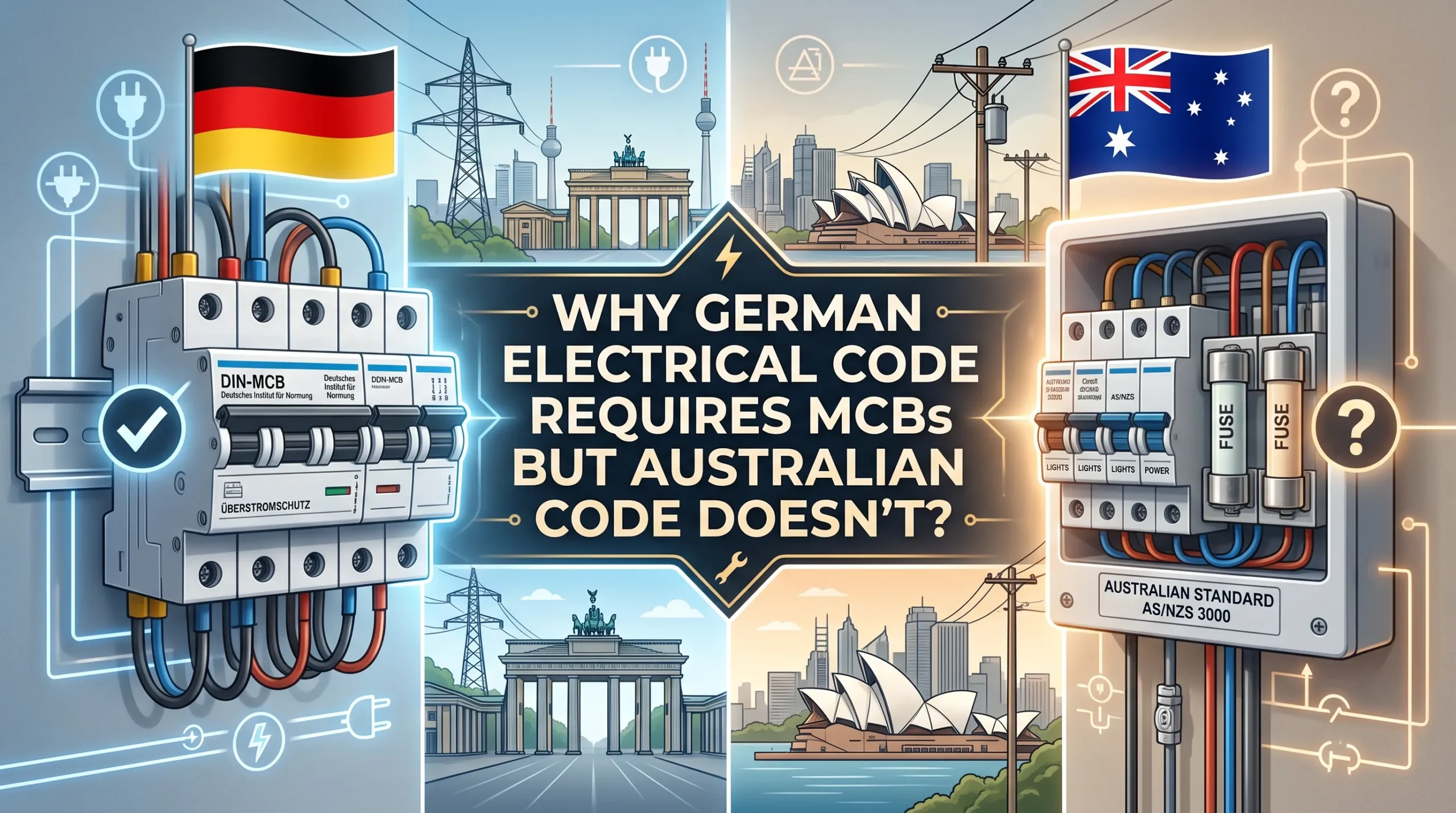
Here’s the puzzle that makes electricians on two continents mildly disagree: the same SPD hardware, built to the same international test standard, can be legally installed in Germany with a backup MCB and legally installed in Australia without one. That’s not a loophole or an oversight. It’s the product of two different national wiring philosophies sitting on top of one shared international rulebook, IEC 61643, which both countries reference when testing the SPD itself.
Key Takeaway
Whether your surge protector needs a dedicated MCB depends on two things: whether the SPD already has a built-in disconnection device, and what your country’s wiring code says about backup protection for that specific installation. There is no universal law of physics demanding an extra breaker.
Germany’s DIN VDE tradition, particularly DIN VDE 0100-534, tends to require external backup protection because of how German low-voltage networks are earthed and how the standard defines coordination between the SPD and upstream devices. Australia’s AS/NZS 3000 wiring rules often permit SPDs with integrated thermal disconnectors to skip the separate MCB, provided the manufacturer’s installation instructions are followed and the device coordinates properly with the switchboard’s existing RCD protection.
Before assuming either rule applies to your house, check the specific product’s installation manual and the current clause of your local code, because this varies by product family and by jurisdiction, and both get revised.
Why the Comparison Even Matters
This isn’t just standards trivia for electricians with strong opinions about earthing diagrams. It matters to anyone renovating an older home, importing electrical gear, or reading a product manual translated from German (or written for the Australian market) and wondering why the wiring diagram includes a component their local supplier didn’t mention. SPDs have become common in both countries as lightning strikes, grid switching events, and increasingly sensitive electronics make surge damage a real (if overstated by marketing departments) household risk. The disconnect between what different rulebooks demand is a genuine source of consumer confusion, and it deserves a plain answer rather than a shrug.
How This Comparison Was Put Together
This is a document-based comparison, not a lab test. It draws on the published text of AS/NZS 3000 (Australia’s Wiring Rules), DIN VDE 0100-534 (Germany’s low-voltage installation standard covering surge protection), and the shared international baseline, IEC 61643, which defines how SPDs themselves are tested and classified regardless of which country sells them.
Manufacturer installation manuals from brands sold in both markets, including Schneider Electric, Siemens, Eaton, and Clipsal, were used as secondary evidence, since these documents show how the standards translate into actual switchboard wiring rather than staying abstract. Guidance from regulators such as Energy Safe Victoria and VDE helped interpret how each jurisdiction treats backup disconnection and earthing system type in practice.
No independent testing of specific SPD units was performed here; this is a comparison of what the rulebooks and manufacturer documentation actually say.
Where Germany and Australia Diverge
| Factor | Germany (DIN VDE) | Australia (AS/NZS 3000) |
|---|---|---|
| Dominant earthing legacy | Mixed TN-C-S and TT systems, with TT common in older or rural installations | Predominantly TN-C-S via the Multiple Earthed Neutral (MEN) system |
| Fault current predictability | Lower and more variable in TT sections, complicating coordination | Generally higher and more predictable low-impedance fault paths |
| Backup MCB/fuse for SPD | Typically required for coordination and fire safety | Often optional if the SPD has an integrated disconnector |
| SPD Type placement | Type 1/2 combined units common at the main board due to lightning exposure profile | Type 2 at the main board is standard, Type 3 near sensitive equipment |
| Shared testing baseline | IEC 61643 | IEC 61643 |
| Rationale cited | Selective coordination and protection against SPD failure modes in less predictable fault paths | MEN system’s low impedance path reduces reliance on external backup devices when internal disconnectors are present |
The key finding buried in that table is that the SPD component itself, the part that actually absorbs the surge, is built and tested identically worldwide under IEC 61643. What differs is entirely about backup disconnection philosophy: how each country’s code wants to handle the moment an SPD fails or degrades.
Germany’s historical patchwork of TT earthing, particularly outside dense urban networks, means fault current behavior is less uniform. When an SPD fails short, the fault current available to trip protection can be lower and slower than in a clean TN-C-S system, so DIN VDE leans toward mandating a coordinated external MCB or fuse to guarantee a clean disconnection regardless of local earthing quirks.
Australia’s near-universal MEN system gives switchboards a more consistent, low-impedance path back to source. That predictability is precisely why AS/NZS 3000 is comfortable trusting an SPD’s own built-in thermal disconnector in many installations, since the fault path behaves the same way from Perth to Cairns.
Several manufacturers now sell SPDs with that disconnector already integrated, which is exactly why an Australian electrician can often skip the extra MCB that a German colleague would be required to add, purely because of how each rulebook is worded.
Factors that determine whether a backup MCB is genuinely needed, regardless of country, include:
- Whether the SPD has a built-in disconnector rated for the installation’s fault current
- Selectivity (discrimination) between the SPD’s protection and the upstream main switch or RCD
- The manufacturer’s stated follow current rating for the specific SPD model
- Local regulator interpretation, since state or regional amendments can tighten the base national standard
What This Doesn’t Settle
None of this means Germany is cautious and Australia is careless, or vice versa. It reflects different historical grid architectures and different risk models, not a safety gap. A more useful practical implication: if you’re bringing a European-certified SPD into an Australian installation (or the reverse), the product needs re-assessment against local wiring rules.
A CE mark or VDE approval on the box doesn’t automatically satisfy AS/NZS 3000, and a Clipsal-approved unit doesn’t automatically satisfy DIN VDE.
This comparison is also a snapshot. Standards get revised, and both AS/NZS 3000 and DIN VDE 0100-534 have been amended before and will be again, so always check the currently published version rather than a summary article (including this one). And because this analysis rests on standards text and manufacturer documentation rather than independent lab testing of failure modes across brands, it describes what the rules require, not how every SPD actually behaves under stress.
Individual electricians and local regulators can also add requirements beyond the base national standard, so the rulebook is a floor, not a ceiling.
Looking ahead, continued IEC harmonization work could narrow the gap between German and Australian backup protection requirements over time. Field data comparing actual failure rates of SPDs with and without dedicated MCBs across different earthing systems would be genuinely useful and, as far as this document review found, doesn’t really exist yet in an accessible form. SPDs with smart monitoring and remote disconnect features are already appearing on the market, and future code revisions will likely need to address them explicitly rather than fitting them awkwardly into rules written for simpler devices. In the meantime, clearer plain-language guidance from consumer bodies would save a lot of homeowners from trying to parse wiring standards over breakfast.
Final Thoughts
“Does my surge protector need an MCB” is really “what does my country’s wiring rulebook say” wearing a disguise. The earthing system buried in your walls, not the country of manufacture stamped on the box, decides the answer. Don’t diagnose your switchboard based on a German YouTube tutorial or an Australian forum thread; the person filming it is not standing in your earthing system.
The safest, least argumentative move is asking a licensed local electrician to check your specific SPD against the current version of your local code, rather than trying to win a debate with a manual written in a different country under a different set of assumptions.
FAQ
Does every surge protector need a circuit breaker? No. It depends on whether the SPD has a built-in disconnector rated for your installation. Some do, some don’t, and the manufacturer’s manual will say so explicitly.
Can I install a German-made SPD in my Australian home without extra parts? Not automatically. It needs to be assessed against AS/NZS 3000, since German certification doesn’t guarantee compliance with Australian earthing and backup protection requirements.
What happens if an SPD fails without a backup MCB? If it has a built-in thermal disconnector, that component isolates the failed SPD safely. If it doesn’t, and no external backup protection is fitted where required, a failed SPD can create a sustained fault, which is exactly the scenario backup protection exists to prevent.
Is Australia’s approach less safe than Germany’s? No, it’s a different risk model built around a different earthing system, not a safety downgrade.
Who do I ask to check my home’s SPD setup? A licensed electrician who can reference the current version of AS/NZS 3000 (or DIN VDE 0100-534, depending on your country) and check the specific manufacturer’s installation instructions for your SPD.