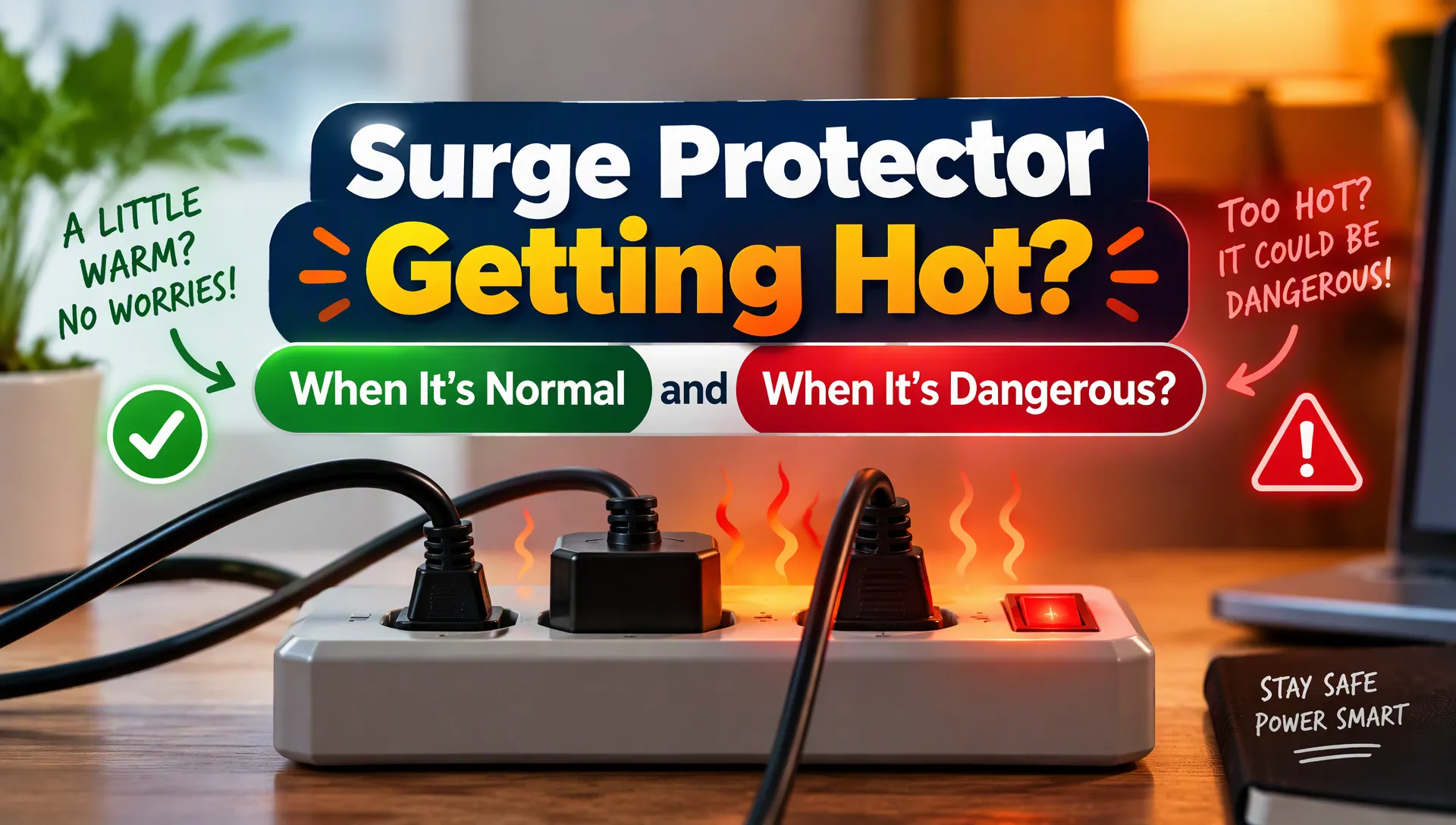
Reaching under your desk to grab a dropped pen and brushing against a surge protector that feels like it just came out of a toaster oven is one of life’s small, specific horrors. You yank your hand back, stare at the thing like it personally betrayed you, and then do what most of us do: nothing. You just quietly note that your power strip is apparently trying to achieve sentience through heat, and move on with your day.
Here’s the problem with that approach. Most people never think about their surge protector until the moment it feels hot, smells faintly like a candle shop gone wrong, or makes a noise it has no business making. At that point you’re left guessing: is this normal electrical warmth, or is this the opening scene of a house fire documentary?
This article sorts that out. Below is a practical breakdown of why surge protectors warm up in the first place, how to tell ordinary warmth from genuine danger, what usually causes the dangerous kind, and when it’s time to retire a unit instead of trusting it with your laptop, your router, and your dignity.
Key Takeaway
- Mild, consistent warmth while a surge protector is under load is normal. Hot-to-the-touch, discoloration, melted plastic, or a burning smell is not.
- Overloading, daisy-chaining extension cords, and cheap or aging units are the most common causes of dangerous heat buildup.
- Surge protectors wear out internally even while they still technically “work.” They are not forever devices, no matter how sturdy they look.
- If you’re genuinely unsure which category your warm power strip falls into, unplug it, let it cool, and replace it. Guessing wrong is not worth the risk.
The Science Bit: Why Surge Protectors Get Warm in the First Place
Every surge protector carries electrical current through internal wiring and components, and that movement of electricity always generates some resistance heat. This is basic physics, not a malfunction. The more devices you have plugged in and drawing power, the more current flows through the strip, and the warmer it will naturally run.
The component actually responsible for “surge protection” is usually a metal oxide varistor, or MOV. When a voltage spike hits, the MOV absorbs it and diverts the excess energy away from your devices, and that absorption process generates heat as a byproduct. A little warmth near the outlets during or after a surge event is the MOV doing exactly its job, not a warning sign.
UL, the safety certification organization whose logo you’ve seen on basically every electrical product you own, sets operating temperature standards for listed devices specifically because some warmth is expected and accounted for in a properly designed unit. The issue isn’t warmth itself. It’s warmth that exceeds what the design allows, usually because something is trapping heat that would otherwise dissipate.
That’s also why covering a surge protector with a blanket, shoving it into a closed cabinet, or burying it under a pile of cables is a bad habit. These units are designed with some assumption of airflow around them. Smother that airflow and ordinary operating heat, which would normally disperse into the room, builds up instead. The NFPA specifically flags poor ventilation and improper placement as contributing factors in electrical fires involving cords and power strips.
Normal Warm vs. Dangerously Hot: A Quick-Reference Table
| Signal | Normal Operation | Dangerous / Needs Action |
|---|---|---|
| Touch temperature | Slightly warm, comparable to a phone charger | Hot enough that you pull your hand away reflexively |
| Smell | None | Burning plastic, acrid, or “electrical” odor |
| Visual condition | Clean housing, intact plug prongs, no marks | Discoloration, scorch marks, melted or warped plastic |
| Sound | Silent or a faint, steady hum | Sizzling, popping, crackling, or buzzing |
| Indicator light | Steady, consistent with manual | Flickering, dim, or completely dead when it should be lit |
| Recommended action | Continue normal use, recheck occasionally | Unplug at the wall immediately, inspect, likely replace |
This kind of checklist mirrors guidance from the Consumer Product Safety Commission and the Electrical Safety Foundation International, both of which list burning smells, discoloration, and unusual sounds as classic early warning signs of an electrical fire hazard, not quirks to shrug off.
Usual Suspects: What Actually Causes Dangerous Overheating
Overloading. Plugging a space heater, a window AC unit, and a laser printer into the same standard surge protector is asking a device rated for maybe 15 amps to handle a load it was never built for. Appliances with heating elements or motors draw significantly more power than electronics, and they belong in a wall outlet directly, not a shared strip.
Daisy-chaining. Plugging one surge protector into another, or into an extension cord, multiplies the load on the first unit’s wiring and connectors in a way manufacturers explicitly warn against. Both APC and Belkin, two of the larger surge protector makers, specifically instruct against chaining protectors together in their product manuals.
Cheap, uncertified units. A surge protector without UL or ETL certification may use thinner internal wiring, lower-quality MOVs, or skip thermal safeguards entirely to hit a lower price point. The $6 power strip from a gas station checkout line is not held to the same standard as a certified unit, and it shows.
Aging MOVs. Every surge, even small fluctuations you never notice, slightly degrades the MOV’s capacity to absorb future spikes. After enough cumulative wear, or one serious event like a lightning strike nearby, the MOV can fail in a way that generates excess heat instead of properly diverting it.
Physical damage. Frayed cords, bent prongs, or a cracked housing exposing internal wiring are straightforward fire risks regardless of load. If you can see wire, retire the unit.
Poor placement. As mentioned above, tucking a surge protector under a rug, mashing it behind furniture against a wall, or stuffing it into an unventilated cabinet traps heat that would otherwise be harmless.
The U.S. Fire Administration and NFPA both track extension cords and power strips as recurring contributors to home electrical fires, usually tracing back to one of the causes above rather than a mysterious manufacturing defect.
The “It’s Hot, Now What?” Action Plan
If you’ve just had your own under-the-desk horror moment, here’s the sequence:
- Unplug it at the wall, not just at the power switch on the strip itself, and let it cool before handling it further.
- Inspect it for melted plastic, scorch marks, or any lingering burning smell.
- Check the load. Add up the wattage of everything that was plugged in and compare it against the strip’s rated capacity, usually printed on a label on the underside.
- If there’s visible damage or odor, don’t reuse it. Dispose of it and move on. It is not worth testing fate to save twelve dollars.
- If it checks out clean, redistribute the load across outlets or circuits and keep an eye on it the next few times you use it.
If the heat seems to be coming from the wall outlet itself rather than the strip, that’s an electrical issue inside your walls, and it’s time to call a licensed electrician rather than troubleshoot further on your own.
Surge Protectors Don’t Last Forever (Even If They Still “Work”)
Here’s the sneaky part nobody warns you about: a surge protector can still happily supply power to your devices with zero actual surge protection left inside it. The outlets work, your laptop charges, everything seems fine, but the MOV that was supposed to protect against voltage spikes has quietly given up.
Manufacturers like Tripp Lite and APC generally recommend replacing surge protectors every few years under normal use, and immediately after any major surge event such as a lightning strike or power grid fluctuation. Some models include a dedicated indicator light specifically to show whether surge protection is still active, separate from the power-on light. It’s worth checking your manual to see if your unit has one, and worth checking that light occasionally instead of assuming it’s fine forever.
Buying a Safer Surge Protector: What to Look For
When it’s time to replace a unit, a few features separate a genuinely protective surge protector from a glorified extension cord:
- UL or ETL certification, non-negotiable baseline.
- Joule rating and amperage matched to your actual intended use, higher for home office or entertainment setups with sensitive electronics.
- Thermal fuses or automatic shutoff features that cut power before heat becomes a hazard.
- A clear surge protection status indicator, so you’re not relying on guesswork years down the line.
- No high-wattage appliances. Space heaters and window AC units should go directly into wall outlets, full stop, regardless of how good the surge protector is.
Consumer Reports publishes independent testing and model recommendations if you want a second opinion beyond the marketing copy on the packaging, and the OSHA guidelines on electrical safety are a useful reference if you’re setting up a home office with multiple devices running simultaneously.
Final Thoughts
A little warmth on a surge protector that’s working hard is nothing to lose sleep over. It’s electricity doing what electricity does. The actual danger signs, hot-to-the-touch housing, burning smells, melted plastic, and strange noises, are comparatively rare, but they’re worth taking seriously the moment they show up.
Make a habit of occasionally running your hand over the power strips in your life, especially the ones hidden under desks or behind entertainment centers where you’d otherwise never notice a problem until it became a big one. Your toaster gets more daily respect and visual inspection than your surge protector ever does, and that’s backwards. Give the power strip a little attention too. It’s quietly protecting several hundred dollars of electronics, and it deserves at least a glance now and then.
FAQ
Is it normal for a surge protector to be warm when nothing is plugged into some outlets? Yes. Warmth is tied to overall current flow through the unit, not to whether every single outlet is occupied. A strip running a few devices can still feel mildly warm near the main components.
Can a hot surge protector actually start a fire? Yes, under the wrong conditions. Overheating components, degraded MOVs, and damaged wiring are all documented contributors to home electrical fires according to the NFPA and U.S. Fire Administration. It’s not common, but it’s a real risk, not a myth.
How often should I replace a surge protector even if it seems fine? Most manufacturers suggest every few years for regular use, and immediately after a major surge event like a lightning strike. If your unit has a surge protection status light, check it periodically rather than relying on a calendar alone.
Is it safe to plug a space heater or window AC into a surge protector? No. These appliances draw far more current than standard surge protectors are designed to handle. Plug them directly into a wall outlet.
Does a lit indicator light always mean the surge protection is still working? Not necessarily. Many units have a separate light for “power on” versus “surge protection active.” Check your manual to understand what your specific indicator light actually represents.
What’s the difference between a power strip and a surge protector when it comes to heat risk? A basic power strip just distributes outlets with no protective components, while a surge protector includes MOVs or similar components that absorb voltage spikes. Both can overheat under overload or damage, but a surge protector has additional internal parts that can degrade or fail over time in ways a plain power strip simply doesn’t have.