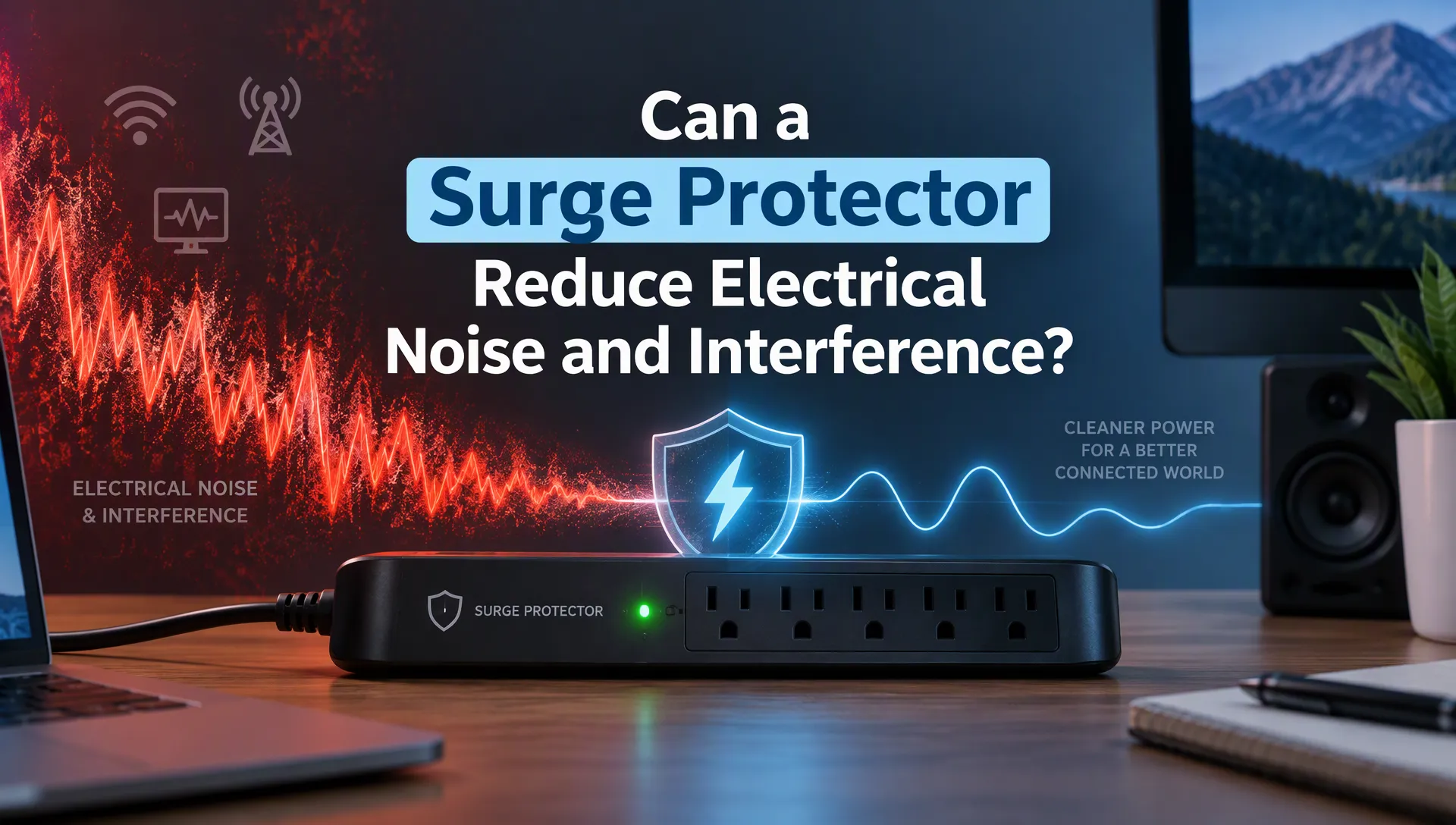
A surge protector can reduce some electrical noise when it includes a filter designed for that purpose, but surge protection alone does not promise quieter audio, clearer radio reception, or a cure for buzzing equipment. This source-based review considers electrical-safety guidance, technical explanations, and product information; it does not test individual devices. The practical approach is to identify the symptom, check the product’s documented filtering features, and investigate other possible causes if the noise persists.
Introduction and Background
A speaker hums, a radio crackles, or a screen flickers. These symptoms can be related to electrical interference, but they can also come from the equipment, cables, signal source, or wiring. A voltage surge and electrical noise are both power-quality concerns, yet they are not the same problem.
A surge is a brief rise in voltage. Surge-protective devices are designed to limit or divert damaging transient overvoltage. Electrical noise is an unwanted electrical disturbance. Some devices include filtering intended to reduce certain noise traveling along power lines, but that is a separate feature.
The National Institute of Standards and Technology’s Electromagnetics program provides background on electromagnetic compatibility, the broader field concerned with how electrical and electronic devices interact. Here, the key questions are narrower: what a surge protector is designed to do, when it may also filter noise, what specifications support that claim, and what it cannot be expected to fix.
Key Takeaway
Some surge protectors include EMI/RFI filtering, which may reduce certain kinds of conducted electrical noise. But “surge protector” by itself is not evidence of noise filtering. Look for explicit filtering specifications and performance details for the specific model. A power strip can be useful, but it is not a universal cure for every mysterious buzz.
Methodology
This article reviews safety guidance, technical reference material, standards information, and manufacturers’ product descriptions. Each source is used for the claims it can support: safety resources for safe use, technical sources for general explanations, and product pages for examples of features that vary by model. Manufacturer descriptions are not independent product tests.
No products were tested, and this article cannot diagnose a reader’s wiring or establish that a particular symptom comes from noise on the mains supply. Where a product’s filtering performance matters, consult its current documentation and the stated test conditions.
Findings and Analysis
Surge protection and noise filtering address different electrical problems. A surge-protective device is intended to limit transient overvoltage. EMI/RFI filtering targets certain unwanted electromagnetic or radio-frequency signals. A device may do both, but one function does not automatically establish the other.
The UL overview of surge-protective devices provides safety and device context. NEMA’s standards information is useful for understanding standards related to surge-protective devices. A surge-protection standard, however, should not be mistaken for a noise-filter performance rating.
| Device type | Primary purpose | Noise-filtering evidence to look for | What not to assume |
|---|---|---|---|
| Basic power strip | Adds outlets | No filtering claim unless the specifications state one | That it protects against surges or reduces noise |
| Surge protector | Limits certain transient overvoltages | A separate, explicit EMI/RFI filtering claim and performance details | That a joule rating or protection indicator measures noise filtering |
| Surge protector with specified EMI/RFI filtering | Combines surge protection with filtering intended for certain interference | Attenuation data, frequency range, units, and test conditions, if provided | That it will fix noise from every source or path |
| UPS | Provides battery backup and may provide surge protection or other power conditioning | Documentation for the particular model’s filtering or conditioning features | That every UPS filters noise, or that filtering will resolve a device or wiring problem |
Filtering is design- and frequency-dependent. Its effect can vary with the type of interference, how that interference reaches the equipment, the filter design, and the connected devices. Noise can enter through a power cable, but it may also arrive through signal cables or be generated within the affected equipment. A power-line filter cannot be expected to fix every route.
When comparing products, look for the exact terms EMI/RFI filtering or noise attenuation, then check whether the documentation gives measured performance, frequency ranges, units, and test conditions. A vague “clean power” claim gives less usable information than a defined specification. Joule ratings describe surge-energy capacity under the relevant product rating method; they do not tell you how well a device filters noise. Likewise, a surge-protection indicator reports something about surge protection, not necessarily filtering performance.
Product pages illustrate why model-specific checking matters. Eaton’s surge-protection information, APC’s surge-protector range, and Tripp Lite’s surge-protector listings are vendor sources, not independent comparisons. Use them to find the specifications for a particular model rather than treating a brand category as proof that every product has the same filtering features.
Symptoms also need context. The FCC’s consumer guidance on radio, television, and telephone interference discusses possible sources and troubleshooting for signal interference. Electrical noise is one possibility, but the symptom alone does not identify the cause. Fluke’s power-quality material offers practical background on power-quality concerns and potential sources.
https://www.youtube.com/watch?v=YvV8V0gR9vY&pp=ygUoUmVkdWNlIEVsZWN0cmljYWwgTm9pc2UgYW5kIEludGVyZmVyZW5jZQ%3D%3D
A useful first step is to note which devices are affected and whether the problem follows one device, one outlet, or one signal connection. Consult the equipment manuals and check whether the noise changes when nearby devices or cables are moved. These observations may help narrow the problem, but they do not prove that the mains supply is responsible.
For audio hum or speaker buzz, possible causes include the audio equipment, connected cables, grounding or wiring conditions, nearby electronics, or the signal path. A filter could help if the interference is conducted through the power connection and the filter is suited to it. It may do little if the noise is entering by another route or being produced within the equipment.
For radio or television interference, identify whether the issue affects one receiver or several and follow relevant equipment guidance. A surge protector is not a general-purpose interference detector, and swapping one in without checking the source can turn troubleshooting into an expensive game of “maybe this time.”
Do not remove grounding pins, open electrical equipment, or make wiring changes as a shortcut. The Consumer Product Safety Commission’s electrical and electronics safety guidance advises on safe use, including avoiding overloaded outlets. For electrical hazards and workplace safety context, see OSHA’s electrical safety resources. Persistent problems, suspected wiring faults, heat, sparking, shocks, or burning smells call for qualified help, not a more optimistic power strip.
The evidence also has limits. Safety and standards pages explain device context, not the noise-filter performance of every consumer product. Manufacturer claims can help identify stated features, but they are not independent tests. And performance in one installation may not predict performance in another.
Implications and Future Research
Choose a product for the problem you have. If surge protection is the goal, compare appropriate safety and surge-protection specifications. If noise filtering is also important, verify that the exact model documents EMI/RFI filtering and look for measurable performance details. Do not use joule ratings as a shortcut for that comparison.
Manufacturers could make comparisons easier by publishing clearer, consistent filtering data, including relevant frequency ranges and test conditions. Independent testing under defined conditions could also separate surge-limiting results from noise-attenuation results. More evidence about how often consumer noise complaints actually trace to the power supply, and how product performance translates to real installations, would make buying advice more precise.
Final Thoughts
Some surge protectors can reduce certain kinds of electrical noise, but filtering is a model-specific feature, not an automatic benefit of surge protection. Check the specifications and investigate the source of the noise before buying the first device whose packaging promises peace and quiet.
FAQ
Does every surge protector filter electrical noise?
No. Specifications vary. Look for an explicit EMI/RFI filtering claim and supporting performance information for the specific model.
Will a surge protector stop audio hum or speaker buzz?
It may help if the noise is traveling through the power line and the protector has suitable filtering. But hum and buzz can also come from audio equipment, cables, grounding or wiring conditions, nearby electronics, or the signal path.
Do joule ratings show how well a surge protector filters noise?
No. A joule rating is not a noise-filtering performance measure. Check for separate filtering specifications.
Can a surge protector fix radio or TV interference?
Sometimes a filter may help if the interference is entering through the power line, but the source and path matter. Follow equipment guidance and the FCC’s troubleshooting advice rather than assuming every interference problem is a surge-protector problem.
When should I contact an electrician or equipment manufacturer?
Contact an electrician for persistent problems or suspected wiring faults, and contact the equipment manufacturer when the issue appears tied to a particular device. Heat, sparking, shocks, or burning smells are safety concerns that warrant prompt professional attention.