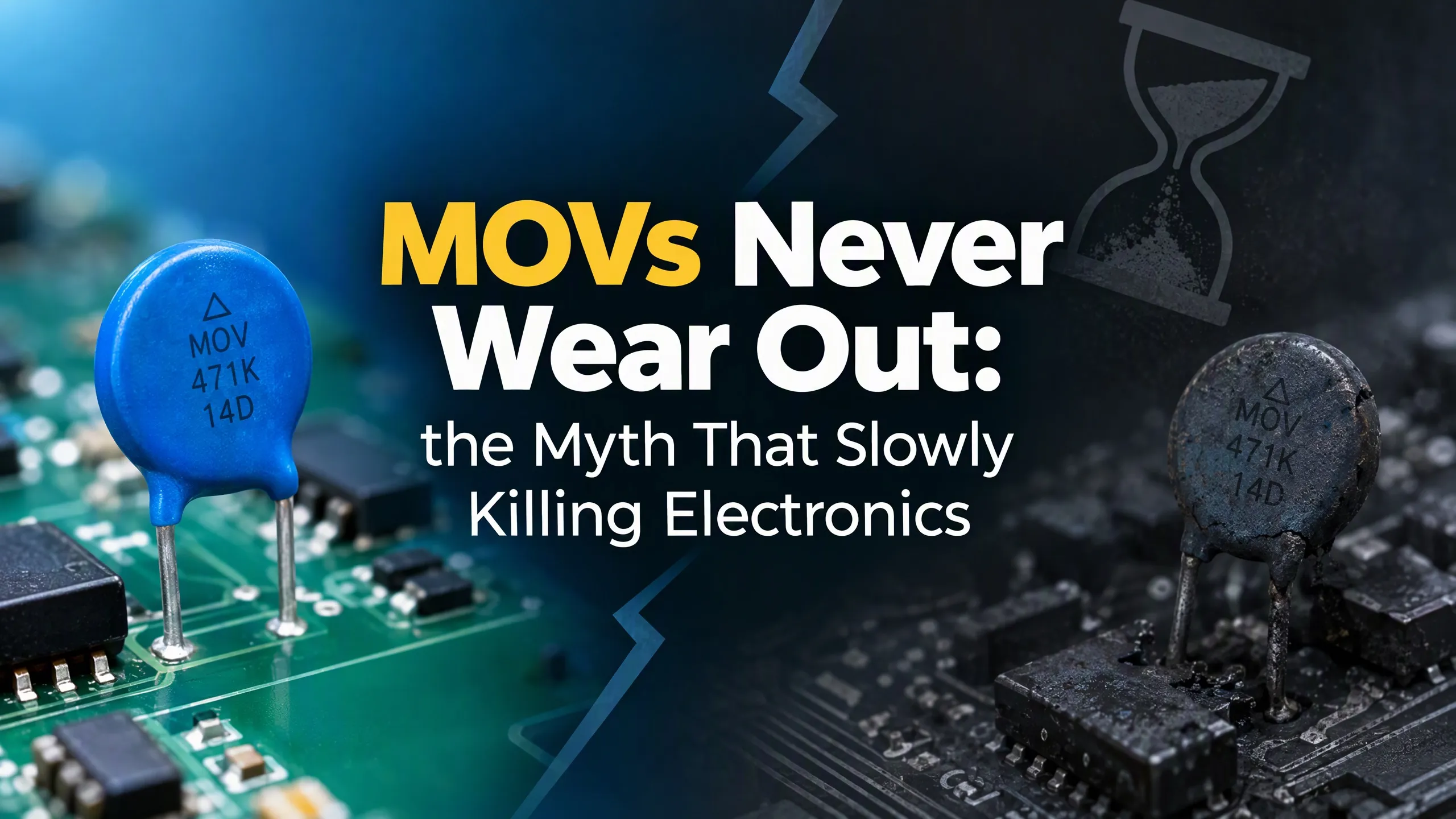
Every surge protector you have ever owned has a tiny, unglamorous hero inside it called a Metal Oxide Varistor (MOV). It is the component that jumps in front of voltage spikes so your laptop and TV do not have to. And here is the uncomfortable truth: that hero gets a little weaker every single time it does its job. Yet the sticker on your power strip says “lifetime warranty,” so most people assume the protection lasts forever too. It does not, and the gap between what consumers believe and what actually happens inside these devices is quietly responsible for a surprising number of dead electronics and, in worse cases, melted plastic and small fires.
The myth: MOVs provide constant, unchanging surge protection for the life of the product.
The reality: MOVs are sacrificial components. Each surge event physically degrades their internal structure, gradually raising the voltage at which they start clamping and shrinking the total energy they can absorb before they fail. A review of manufacturer datasheets, UL and IEC surge protection standards, and engineering literature on varistor behavior confirms that MOV degradation is cumulative, predictable, and largely invisible to the average user. The practical stakes are not trivial. The Consumer Product Safety Commission has documented fires linked to surge protectors, and cheaper units without thermal fuses are particularly prone to overheating rather than failing safely once their MOV has been worn down. In short, “lifetime warranty” was never a promise about lifetime performance, and treating your surge protector like an indestructible force field is a bet you will eventually lose.
What an MOV Actually Is (and Why It’s Everywhere)
A Metal Oxide Varistor is a voltage-dependent resistor built from zinc oxide grains pressed together into a ceramic-like disc. Under normal household voltage, it behaves like a bystander, barely conducting any current. But when voltage spikes past a certain threshold (say, during a lightning strike or a refrigerator compressor kicking on), the MOV’s resistance collapses almost instantly, and it shunts the excess energy away from your electronics and toward ground. MOVs became the default surge-suppression component in everything from $6 power strips to $150 “premium” units for a simple reason: they are cheap, fast, and simple to wire in.
According to Littelfuse’s varistor application notes, a single MOV can respond to a surge in nanoseconds, far faster than a mechanical circuit breaker could ever manage. That speed and low cost made MOVs the industry’s default answer to a nagging problem, which is also exactly why so many people never think about them again once they are plugged in.
The myth of immortality seems to have grown out of marketing language.
Manufacturers advertise “lifetime warranties” on surge protectors, which is a promise about the plastic housing and the connected-equipment guarantee, not a technical claim about the varistor’s remaining joule capacity. Consumers, understandably, read “lifetime” and assume the protection itself is permanent. It is a bit like assuming your car’s brake pads are covered forever because the car has a lifetime rust warranty.
Key Takeaway
- MOVs absorb energy during every surge, and that absorption physically degrades the zinc oxide grain structure inside them.
- Each surge nudges the clamping voltage higher and eats into the MOV’s remaining energy capacity, even while the device still technically “works.”
- Basic surge protectors give no visible warning when the MOV has degraded past the point of being useful.
- Industry guidance generally recommends replacing surge protectors every 2 to 5 years, or immediately after any known major surge, rather than waiting for visible failure.
Methodology
This article is a synthesis, not a new lab study. The claims here are drawn from publicly available manufacturer datasheets and application notes from varistor producers such as Littelfuse, Panasonic, and Vishay, cross-referenced against the UL 1449 standard for surge protective devices and the IEC 61643 series, both of which include end-of-life and degradation testing requirements. These were checked against engineering references discussing surge protective device life-cycle behavior, along with consumer-facing guidance from Consumer Reports and the Consumer Product Safety Commission on replacement schedules and documented fire risk.
No original lab testing was performed for this piece, and that is worth flagging upfront: real-world degradation rates vary by surge frequency, magnitude, and the quality of the specific MOV in question.
Findings and Analysis
Every time an MOV clamps a surge, it briefly absorbs a burst of thermal and electrical stress at its zinc oxide grain boundaries. This is not a clean, reversible event. The grain boundaries undergo microscopic structural changes, and those changes accumulate. It is the electronic equivalent of bending a paperclip back and forth. It survives the first few bends just fine, and then one day it just snaps, usually at the worst possible time.
Two metrics capture this drift clearly.
Clamping voltage increases over time. A new MOV might clamp at a specified voltage, but after repeated surges, engineering literature on varistor aging shows that threshold creeps upward. Practically, that means the MOV lets more voltage through to your devices than it used to, even though it still “activates.”
Joule rating shrinks with cumulative use. Every MOV has a maximum energy absorption rating, measured in joules, and that rating is not a per-event limit you get to reuse indefinitely. It behaves more like a lifetime energy budget. A large surge, or many small ones, spends down that budget permanently.
| Surge Exposure Stage | Typical Clamping Voltage Behavior | Remaining Joule Capacity | Practical Risk Level |
|---|---|---|---|
| New / unused | At manufacturer spec | ~100% | Low |
| Light use (minor surges) | Slight upward drift | ~80 to 90% | Low to moderate |
| Moderate use (repeated small surges or one large one) | Noticeable upward drift | ~40 to 60% | Moderate |
| Heavy use (multiple large surges) | Significant drift, reduced clamping effectiveness | Under 20% | High |
| End of life | Fails to clamp properly, or fails short/open | Near 0% | High, potential overheating |
Figures represent generalized behavior patterns synthesized from manufacturer datasheets and standards discussions rather than a single controlled experiment, since real degradation curves vary by MOV design and surge profile.
The fire-risk pathway matters here too. Higher-quality surge protectors pair their MOV with a thermal fuse, so that when the varistor finally degrades to the point of drawing excessive current, the fuse cuts power before things get hot. Cheaper units sometimes skip that safeguard entirely, meaning a badly degraded MOV can overheat, discolor, or even combust instead of failing quietly. The CPSC has documented fire incidents tied to surge protectors for exactly this reason.
The practical consequences line up in a predictable, slightly grim list:
- Reduced protection during future surges, right when it matters most
- Silent failure with no warning light on many basic models
- Documented cases of overheating and fire risk in units lacking thermal fuses
- A false sense of security from “lifetime warranty” language that has nothing to do with ongoing performance
Discussion
The “lifetime warranty” myth persists partly because it is technically true in a narrow sense. Manufacturers really will replace the product or reimburse connected equipment if it fails. But that guarantee describes a business policy, not the physics happening inside the housing. UL certification adds to the confusion in a subtler way: it confirms a device meets minimum performance standards when new, not that it will maintain that performance after years of absorbing surges.
There is real variability here too.
The quality of the MOV itself, whether the unit includes a thermal fuse, and general design choices all affect how gracefully a surge protector ages.
A $40 unit with diagnostic indicators and a thermal cutoff is a genuinely different product from a $6 strip with a single bare MOV soldered in, even though both say “surge protector” on the box. This article leans on published specs and standards rather than independent longitudinal testing, so exact degradation timelines should be read as informed estimates rather than guarantees.
Implications and Future Research
The practical takeaway is straightforward: treat surge protectors as consumable safety equipment, similar to smoke detector batteries, rather than permanent fixtures. Replace them on a schedule, and definitely after a known major surge or storm-related outage. When buying new ones, prioritize models with built-in indicator lights or audible alarms that flag MOV degradation, along with thermal fuse protection and a solid joule rating.
Independent longitudinal studies tracking clamping voltage and joule capacity in real households over several years would help quantify actual degradation curves rather than manufacturer estimates. Clearer, standardized labeling that separates “protection life” from “warranty life” would also go a long way toward closing the gap between what consumers assume and what is actually happening inside the box.
Final Thoughts
An MOV is basically a boxer who agrees to take a punch on your behalf every time lightning strikes or the power grid hiccups. It survives the first punch. It survives the tenth. But nobody keeps taking punches forever without slowing down, and your surge protector is no exception. The scary part is that it never tells you it is getting tired until it either quietly stops protecting you or, in rarer cases, overheats.
So do the boring but useful thing today: check how old your surge protectors actually are, note whether they have been through any major storms, and swap out anything that is unmarked, ancient, or has clearly taken a hit. Your electronics will not thank you, but your circuit breaker might.
FAQ
How do I know if my surge protector’s MOV has degraded? Look for indicator lights (if the model has them), unusual warmth, discoloration around the outlets, or simply track its age and surge history. No visible signs does not mean no degradation.
Does unplugging devices during storms help extend MOV life? Yes. Unplugging avoids surge exposure entirely for that event, which preserves whatever energy capacity the MOV has left.
Are more expensive surge protectors actually better? Generally yes, particularly if they include thermal fuses, diagnostic indicators, and higher joule ratings rather than just a bigger price tag.
Can a whole-house surge protector replace power strip surge protectors? It reduces the size of large surges reaching your outlets, but point-of-use protection is still recommended as a second layer for sensitive electronics.
How often should surge protectors really be replaced? Industry and consumer-safety guidance generally suggests every 2 to 5 years, or immediately after any known major surge event, regardless of whether the unit still seems to work.