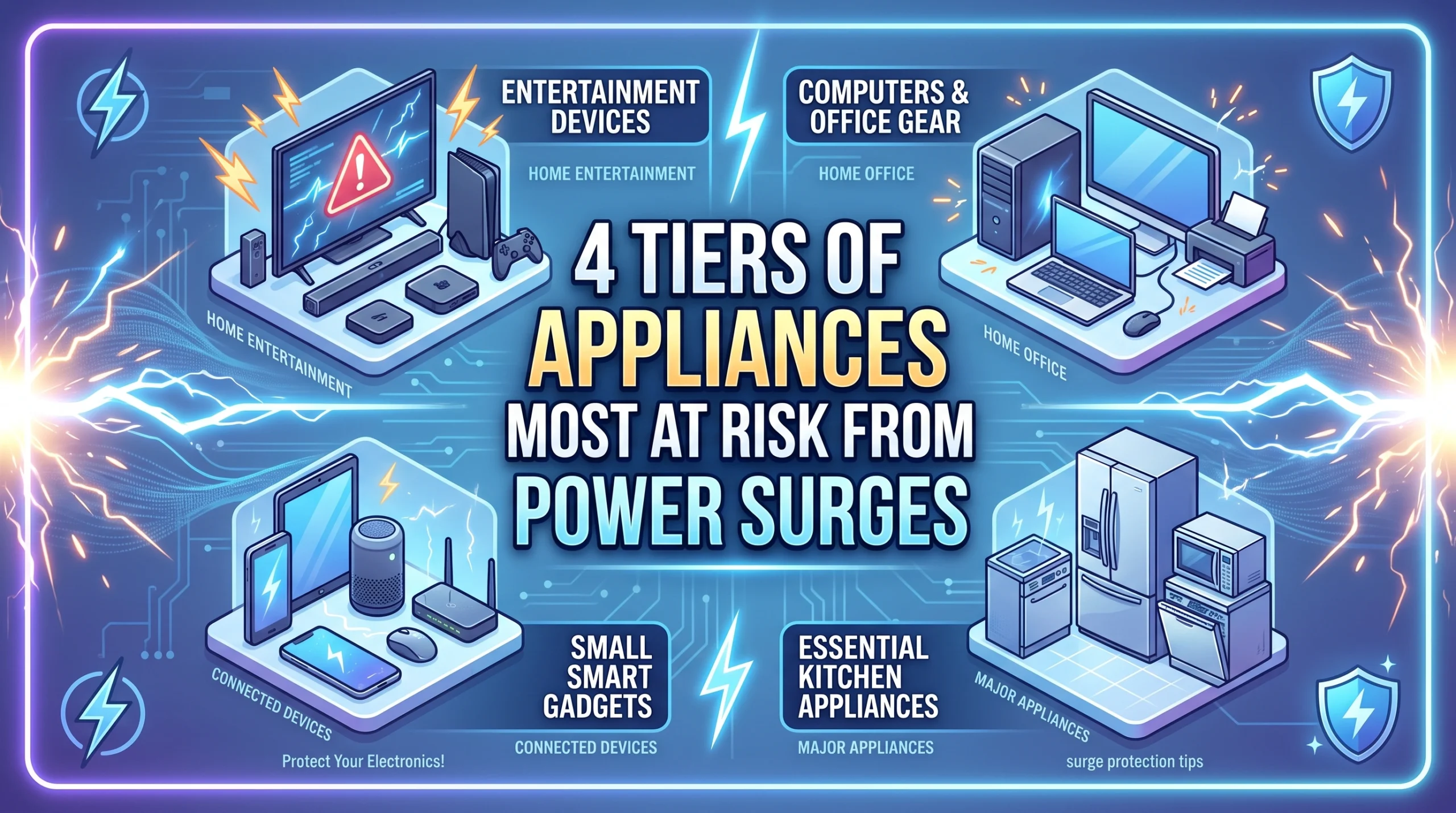
The appliances most at risk from power surges are not necessarily the biggest or most expensive ones. The real vulnerability usually comes from what is inside: electronic control boards, inverter drives, digital displays, Wi Fi modules, and connections to phone, cable, or data wiring. A basic toaster may tolerate an event that disables a smart refrigerator’s control board.
I recommend thinking about surge risk through two lenses: sensitivity and consequence. Sensitivity is the chance that a voltage spike harms the appliance’s electronics. Consequence is what happens if it fails: spoiled food, no heating or cooling, a flooded laundry room, an inoperable garage door, or lost work from an offline computer.
TL;DR: Protect appliances with control boards, digital controls, inverter motors, or communications wiring first. HVAC equipment, refrigerators, smart laundry appliances, garage door openers, computers, TVs, routers, and cable connected equipment deserve priority. A whole home surge protector is the foundation, while plug in protection and signal line protection help cover sensitive electronics near the point of use.
Key Takeaways
• Appliances with electronic control boards are generally more vulnerable than simple heating loads.
• Large appliances can create switching events inside the home, so lightning is not the only concern.
• Refrigerators, HVAC systems, smart washers, dishwashers, garage door openers, computers, networking devices, and TVs should usually be prioritized.
• A device can suffer hidden, cumulative damage and still appear to work after a surge.
• Whole home surge protection works best as part of a layered plan that also considers plug in and communication line pathways.
How to Rank Appliance Surge Risk
The three factors that matter most
A useful ranking starts with the appliance’s internal design, not its wattage. I would assess each item using these three questions:
| Risk factor | Why it raises vulnerability | Examples |
|---|---|---|
| Electronic controls | Circuit boards and microprocessors can be damaged by brief overvoltage | Refrigerators, ovens, washers, HVAC systems |
| Variable speed or inverter electronics | These components manage motors electronically and can be more sensitive than simple mechanical switching | Heat pumps, mini splits, modern washers, high efficiency refrigerators |
| External signal connections | A surge can enter through data, phone, cable, or network wiring as well as power wiring | Modems, TVs, alarms, garage door openers |
NIST’s consumer guidance ranks appliance categories by surge sensitivity and notes that exposure can arrive through both power conductors and attached communication lines. Its broad conclusion is useful: basic motor driven and heating appliances tend to be less sensitive than free standing electronics, communications connected devices, and signal systems. See NIST’s surge sensitivity guidance for household equipment for the underlying category framework.
That does not mean every motor appliance is safe. A decades old washer with a mechanical timer is different from a current smart washer with a touch panel, electronic motor drive, and Wi Fi connection. The motor may be sturdy while the board controlling it is not.
Motor only, hybrid, and communications connected appliances
I find it helpful to place home appliances into three practical groups.
| Appliance group | Typical risk level | Why |
|---|---|---|
| Simple resistive or basic motor loads | Lower | Fewer sensitive electronic components |
| Hybrid appliances with boards and motors | Moderate to high | A control board, relay, display, or inverter can fail before the motor does |
| Communications connected appliances and signal systems | High | They may be exposed through both electrical and signal pathways |
Simple resistive loads include older incandescent bulbs, basic space heaters, simple toasters, and traditional water heaters with minimal electronic control. They are not immune to severe electrical events, but they usually have fewer delicate circuits to damage.
Hybrid appliances are the category many households underestimate. Refrigerators, dishwashers, ranges, microwaves, washers, dryers, and HVAC equipment often blend high power components with low voltage electronics. A surge does not need to destroy the compressor, heating element, or motor to create an expensive repair. It only needs to damage the board that tells that component when to run.
Communications connected exposure deserves special attention. NIST places signal systems such as garage door openers, intercoms, and intrusion alarms among more sensitive groups. If an appliance has an Ethernet cable, coaxial cable, telephone line, smart hub, or outdoor sensor connection, outlet protection alone may not cover every path.
Why internal surges change the priority list
A surge is not always a dramatic lightning event. The Electrical Safety Foundation International explains that power surges can also occur when large appliances, including air conditioners, switch on and off. Read ESFI’s explanation of appliance switching surges for that distinction.
This matters because a home can experience repeated smaller events during ordinary operation. A central air conditioner starting, a well pump cycling, or a large motor shutting down can create electrical disturbances on the system. Those events may not instantly kill nearby electronics, but repeated stress can gradually weaken protective components and sensitive circuitry.
Think of it like bending a paper clip. One small bend may not snap it. Repeated bends at the same point eventually do. Electronic parts can experience a similar pattern of cumulative stress from voltage transients, even when no single event produces obvious damage.
Appliances That Deserve Protection First
Tier one: HVAC, heat pumps, and refrigeration
If budget limits what can be protected first, I would start with HVAC equipment, heat pumps, mini splits, refrigerators, and freezers. These systems are essential, expensive to replace, and increasingly dependent on control electronics.
A refrigerator may have a compressor, fan motors, defrost system, sensors, display panel, ice maker, and electronic control board. A surge can damage one small board while leaving the compressor mechanically intact. The result may be intermittent cooling, error codes, a dead display, or a refrigerator that runs at the wrong intervals.
For a closer look at device selection and installation considerations, review these surge protectors for refrigerators. A refrigerator protection device should be appropriate for the appliance’s circuit and electrical load. Avoid treating a low capacity office surge strip as a universal solution for a major kitchen appliance.
HVAC systems deserve the same caution. A furnace, air conditioner, or heat pump often has an outdoor unit, indoor controls, thermostat wiring, and sometimes communicating equipment. Protection may need to address the service panel and equipment specific connections. Because HVAC wiring and electrical equipment vary widely, a qualified electrician or HVAC professional should determine whether a dedicated surge protective device is appropriate.
Tier two: Laundry, dishwashing, cooking, and smart kitchen equipment
Modern washers, dryers, dishwashers, microwaves, ovens, and ranges are often more vulnerable than their older counterparts because they rely on electronic interfaces and programmed cycles. The failure point may be a display board, relay, touch control, motor controller, or sensor circuit.
A washer can still spin after a surge yet have a blank display or unreliable cycle selection. A dishwasher might power on but fail to fill, heat, or drain at the correct time because a relay or control circuit has been affected. These are not always obvious “dead appliance” failures.
CNET’s cited electrician guidance notes that appliances with control boards tend to be more susceptible to surge damage than simpler designs. The practical takeaway is not that every kitchen appliance needs a separate plug in strip. It is that appliances with sophisticated controls deserve a more deliberate plan. See CNET’s discussion of control board vulnerability during storms for that context.
For countertop and kitchen devices, a surge protector for kitchen appliances can help when the device is compatible with plug in protection. Check the appliance manual, electrical rating, outlet access, and manufacturer instructions before connecting anything. High draw appliances should not be crowded onto an undersized strip.
Tier three: TVs, computers, routers, and connected entertainment equipment
Computers, televisions, game consoles, streaming devices, routers, modems, and network attached storage are often among the most sensitive items in a home. They have densely packed electronics, and many are tied to several pathways at once: AC power, Ethernet, coax, telephone, antenna, or HDMI connections.
Energex states that surges can damage appliances connected through electrical or telecommunications wiring and identifies computers, televisions, microwaves, medical equipment, and communication equipment among commonly affected types. Its guidance is especially relevant for cable connected systems because an electrical branch circuit protector does not automatically eliminate signal line exposure. See Energex’s overview of electrical and telecommunications surge paths.
A modem and TV failing during the same storm is not always proof that the wall outlet was the only entry point. Coaxial or data wiring may have carried part of the event. Protection should match every relevant pathway, and signal line protection must be suitable for the specific service and equipment.
Tier four: garage door openers, alarms, and outdoor controls
Garage door openers, alarm panels, intercoms, irrigation controllers, gate systems, landscape lighting controls, and smart home hubs often sit in a difficult position. They may have small electronic boards, long wiring runs, outside connections, and exposure to remote sensors or signal lines.
Their replacement cost may be lower than an HVAC system, but their operational importance can be high. A failed garage opener can leave a vehicle trapped. A damaged alarm panel can leave a home without a security system. In this group, the risk is often about sensitivity and wiring exposure rather than the appliance’s physical size.
How Surge Damage Happens and What It Looks Like
The component that fails is often not the appliance’s main load
When people say a surge “fried” an appliance, they may picture a destroyed motor or compressor. Sometimes that happens. More often, the weaker point is an electronic component that controls the larger load.
| Appliance type | Common vulnerable component | Possible symptom |
|---|---|---|
| Refrigerator or freezer | Main control board, display board, start circuitry | No cooling, erratic cycling, blank panel |
| HVAC or heat pump | Control board, thermostat interface, inverter drive | Won’t start, communication fault, short cycling |
| Washer or dishwasher | User interface, relay board, motor controller | Dead display, incomplete cycle, error code |
| TV or computer | Power supply, logic board, network port | No power, intermittent restart, lost ports |
| Garage opener | Logic board, wall control, safety sensor circuit | No response, reversed motion, flashing diagnostics |
The difficult part is that surge damage may be partial. NIST notes that repeated small surges can create cumulative damage that is not immediately obvious. An appliance may still turn on, but operate inconsistently, reset its clock, lose settings, show unexplained fault codes, or fail under load.
Immediate failure versus hidden degradation
Immediate damage is easier to connect to an event. A TV that will not power on after a nearby lightning strike raises obvious suspicion. Hidden damage is harder. A refrigerator that begins cycling strangely two weeks after a series of outages may have several possible causes, including a stressed control board, unrelated component wear, poor voltage conditions, or a loose connection.
There is no universal diagnostic shortcut. A technician may need to inspect error codes, test incoming voltage, examine boards for visible damage, and rule out ordinary mechanical failure. Fair warning: replacing a board without addressing the electrical cause can leave the replacement exposed to the same problem.
Signs that justify a closer inspection
After an outage, lightning event, or suspected surge, take unusual behavior seriously, especially in high priority equipment.
• A device will not power on, even though the outlet works.
• Digital clocks, settings, or network connections reset repeatedly.
• The appliance operates intermittently or only after being unplugged.
• A display flickers, becomes unreadable, or shows new error codes.
• Circuit breakers trip repeatedly when a particular appliance starts.
• A burning odor, scorch mark, buzzing sound, or hot outlet appears.
If there is heat, smoke, visible damage, repeated breaker tripping, or suspected wiring damage, stop using the equipment and contact a qualified electrician or appliance technician. Do not keep resetting a breaker to “see if it works now.”
Building a Practical Protection Plan
Start with the electrical system, not a pile of strips
A whole home surge protective device at the service equipment can reduce the energy that reaches branch circuits during many surge events. It is the right foundation for protecting hardwired appliances and equipment that cannot realistically use a plug in surge protector.
However, it is not a force field. Distance from the panel, wiring configuration, surge magnitude, grounding quality, and the equipment’s sensitivity all affect results. Plug in surge protectors can add a second layer near sensitive electronics, while dedicated protection may be appropriate for certain appliances.
For readers comparing options for major equipment, this guide to a surge protector for large appliances can help clarify what to look for. The goal is not to connect every appliance to the same device. It is to choose protection that fits the appliance, circuit, and installation method.
Match protection to the appliance and pathway
Use this decision framework before buying or installing anything.
- Protect the service entrance first. A properly installed whole home surge protective device helps cover multiple circuits, including hardwired appliances.
- Add point of use protection for sensitive plug in electronics. Computers, TVs, routers, modems, gaming systems, and smart hubs often benefit from quality plug in protection.
- Address signal pathways. If equipment uses cable, telephone, Ethernet, antenna, or outdoor control wiring, consider whether protection is needed for those connections too.
- Verify grounding and bonding. Surge protection depends on a properly grounded, code compliant electrical system. A surge device cannot correct faulty grounding, loose neutral connections, damaged receptacles, or overloaded circuits.
- Replace protection after a known major event or end of life indication. Many surge protectors use sacrificial components. If an indicator light shows loss of protection, replace the unit rather than assuming the outlets remain protected.
State Farm explains that surge protectors are intended to help shield electronics, including computers, televisions, and kitchen appliances, from sudden voltage spikes. That is the right expectation: help reduce risk, not guarantee survival under every electrical event. See State Farm’s consumer guidance on protecting electronics from voltage spikes.
A sensible storm response rule
Unplugging sensitive electronics can provide physical separation from a power pathway, but it is not always practical or safe to unplug major appliances during a storm. Refrigerators, medical equipment, sump pumps, HVAC systems, and security systems may need to remain operational.
I would use a simple rule: unplug portable, high value electronics when severe weather is approaching and doing so is safe; rely on installed protection for equipment that must stay connected. Shutting off the main breaker is generally a more serious step and should not be a routine storm ritual. It can interrupt sump pumps, refrigeration, alarms, medical devices, and other critical loads. Consider it only when there is an immediate electrical hazard, flooding near electrical equipment, visible service damage, or direction from emergency officials or a qualified professional.
Frequently Asked Questions
Which appliances are most likely to be damaged by a power surge?
The highest priority usually includes HVAC systems, heat pumps, refrigerators, freezers, smart washers, dishwashers, garage door openers, computers, TVs, modems, routers, and alarm systems. Their vulnerability is driven by control boards, sensitive electronics, inverter components, or communications connections.
Are refrigerators more at risk than TVs or computers?
Not always. TVs and computers are usually more electronically sensitive, especially when connected to cable or data lines. Refrigerators may be less sensitive in pure electronics terms, but their control boards can still be damaged and the practical consequence of losing refrigeration can be greater. Protect both, but use the right type of protection for each.
Do washers and dryers need surge protection?
Older, mechanically controlled models may be lower priority than smart laundry machines. Modern washers and dryers with touch panels, electronic control boards, sensors, and variable speed drives deserve more attention. Whole home protection is often the practical baseline for these major appliances.
Can a power surge come from inside the house?
Yes. Large appliances switching on and off can create electrical disturbances. Air conditioners, pumps, compressors, and other motor driven loads can contribute to smaller switching surges. That is one reason surge protection is useful even in areas with infrequent lightning.
Can a surge damage an appliance even if it still turns on afterward?
Yes. Partial damage can appear later as intermittent operation, resetting controls, unreliable sensors, unusual error codes, unstable network connections, or failure under load. If the appliance behaves differently after an event, document the symptoms and have it assessed if the problem continues.
Is a whole home surge protector enough for major appliances?
It is an important first layer, especially for hardwired equipment, but it may not be enough for highly sensitive electronics or devices connected to cable, phone, or data wiring. Layered protection is usually stronger: service panel protection, point of use protection where appropriate, and signal pathway protection when needed.
What appliances are relatively lower risk?
Basic resistive appliances with minimal electronics are generally lower risk. Examples can include simple toasters, traditional water heaters, basic incandescent lamps, and uncomplicated heating devices. They can still be affected by a severe event, but they usually have fewer delicate components than smart or communications connected equipment.
Conclusion and Sources
Protect the controls, not just the biggest loads
The appliances most at risk from power surges are the ones that combine electrical power with sensitive electronics, digital controls, or external communications wiring. Start with HVAC equipment, refrigeration, smart appliances, networking gear, entertainment systems, and garage or security controls. Then build outward with whole home protection, appropriate point of use devices, and careful attention to grounding and signal pathways.
A surge plan is most effective before an outage or storm exposes a weak point. Prioritize the equipment that would be hardest to replace, most disruptive to lose, or most likely to hide delicate electronics behind a large metal cabinet.
Sources and References
- NIST Special Publication 960-6, Surges Happen! How to Protect Your Home Appliances and Electronics — https://nvlpubs.nist.gov/nistpubs/Legacy/SP/nistspecialpublication960-6.pdf
- Electrical Safety Foundation International, Surge Protection – Keeping your Electronics and Home Safe — https://www.esfi.org/surge-protection-keeping-your-electronics-and-home-safe/
- Energex, Surges & spikes — https://www.energex.com.au/safety/incidents-and-emergencies/surges-and-spikes
- State Farm, Are Power Surges Damaging Your Electronics? — https://www.statefarm.com/simple-insights/residence/are-power-surges-damaging-your-electronics
- cnet.com — https://www.cnet.com/home/kitchen-and-household/should-i-unplug-electronics-before-a-thunderstorm/