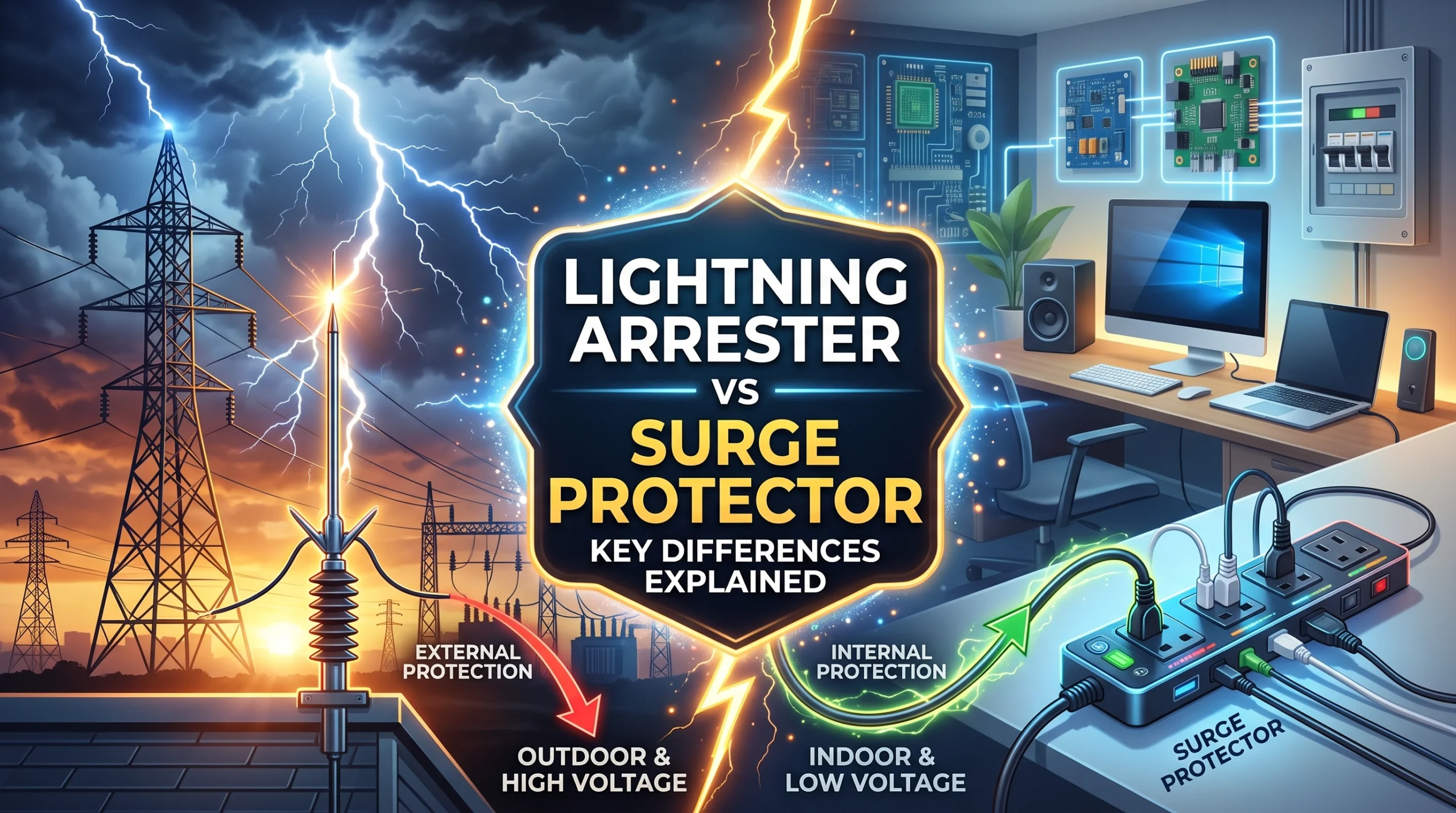
Lightning arresters and surge protectors are easy to confuse because both deal with sudden voltage spikes. But they are built for different threats. A lightning arrester helps move the extreme energy from a lightning strike safely to the ground, while a surge protector helps shield electronics from smaller voltage spikes caused by appliances, grid issues, or nearby storms.
That difference matters if you want real electrical protection. A basic plug in surge protector may help protect your TV, computer, or router from everyday surges, but it is not designed to handle the full force of a direct lightning strike. A lightning arrester can protect the building and electrical system from much larger surges, but it does not replace point of use protection for sensitive devices.
In this guide, you will learn how lightning arresters and surge protectors work, where each one is installed, and why many homes and businesses benefit from using both. You will also see the main differences side by side so you can choose the right protection for your property.
Here is a quick comparison to start with.
|
Feature |
Lightning Arresters |
Surge Protectors |
|---|---|---|
|
Primary Function |
Small surge protection |
|
|
Best Use Case |
Industrial, prone to lightning |
Homes, offices for electronics |
Key Takeaways
-
Lightning arresters protect buildings from direct lightning strikes, while surge protectors shield sensitive electronics from smaller electrical surges.
-
For complete safety, use both devices. Lightning arresters handle high-energy surges, and surge protectors guard against everyday voltage spikes.
-
Regular maintenance and proper installation of both devices are crucial. This ensures your property remains safe from electrical damage.
Lightning Arrester vs Surge Protector Overview
Main Differences
When you compare lightning arrester vs surge protector, you notice clear differences in how each device works and what it protects. A lightning arrester is built to handle the massive energy from direct lightning strikes. You usually find it outside, near the top of a building or on utility poles. Its main job is to redirect high-voltage surges from lightning safely into the ground before they can enter your electrical system.
A surge protector, on the other hand, focuses on smaller, more frequent surges. These surges often come from inside your home or business, like when you switch on large appliances or equipment.
Surge protectors sit inside your main panel or plug directly into outlets. They shield sensitive electronics from voltage spikes that could damage or shorten the life of your devices.
Here’s a quick look at the technical differences:
|
Feature |
Surge Protector (SPD) |
Lightning Arrester |
|---|---|---|
|
Main Function |
Protects electronics from internal surges |
Protects against external lightning strikes |
|
Installation Location |
Inside main panel or at outlets |
Outside, near service entrance or on utility poles |
|
Types of Surges |
Internal (switching, electrical faults) |
External (lightning, high-energy surges) |
|
Voltage Handling |
Low voltage (below 1kV) |
Medium to high voltage (above 1kV) |
|
Energy Discharge |
Diverts surplus energy to ground |
Redirects lightning energy directly to ground |
Note: Many people think surge protectors and lightning arresters do the same thing. In reality, surge protectors focus on your electronics, while lightning arresters protect the whole building from direct strikes.
Protection Scope
You need to understand the protection scope when choosing between lightning arrester vs surge protector. Lightning arresters form the first line of defense in a lightning protection system. They keep your building safe from the huge voltages and currents caused by lightning. Surge protectors, however, guard your appliances and electronics from smaller, more common surges.
Most electrical surges—about 65%—happen inside your building. These come from switching lights, motors, or other equipment. Only about 20% of surges are from lightning or utility problems. That means surge protectors play a big role in everyday surge protection, even though lightning arresters handle the most dangerous events.
|
Feature |
Surge Protector (SPD) |
Lightning Arrester |
|---|---|---|
|
Voltage Handling |
Limits everyday voltage surges |
Handles high transient voltages |
|
Current Handling |
Protects against normal current spikes |
Designed for high surge currents from lightning |
|
Application |
Used for electronics and appliances |
Used for heavy systems exposed to lightning |
If you want complete protection, you should use both devices. The lightning arrester vs surge protector debate is not about which is better, but about which threats you need to address. For most homes and businesses, combining both gives you the best defense against all types of electrical surges.
Many people confuse the roles of these devices. Surge arresters mainly protect the power distribution system, not your connected equipment. Surge protectors, also called Surge Protective Devices (SPD), focus on keeping your electronics safe. The terminology has changed over time, but knowing the difference helps you make smart choices for your property. When you plan your lightning protection strategy, remember that lightning arrester vs surge protector is not an either/or decision. Each device covers a different part of the risk, and together they offer the strongest protection.
What Is a Lightning Arrester?
Definition
A lightning arrester is a key device in any lightning protection system. You use it to guard electrical equipment from the high-voltage surges that come with lightning strikes. When you install a lightning arrester, you give your building a way to safely handle sudden bursts of energy. This device stands as a shield, stopping lightning damage before it can reach sensitive parts of your electrical system.
How It Works
You can think of a lightning arrester as a gatekeeper for your power lines. When lightning strikes, the voltage can rise to dangerous levels. The lightning arrester detects this spike and quickly creates a path for the surge to travel safely into the ground. This action prevents lightning damage to transformers, circuit breakers, and other vital equipment. The main components of a lightning arrester each play a special role:
|
Component |
Function |
|---|---|
|
Spark Gap |
Limits voltage by forming a short-circuit discharge current when overvoltage occurs, quickly releasing current and recovering high impedance. |
|
Varistor |
Discharges lightning surges by sharply decreasing impedance when voltage exceeds a threshold, then restoring high impedance after the event. |
|
TVS |
Limits overvoltage using diode characteristics, with a very fast response time, suitable for protecting communication lines. |
You rely on these parts to keep your electrical system safe during storms. They work together to channel dangerous energy away from your building.
Typical Uses
You often see lightning arresters on tall buildings, industrial facilities, and power plants. These places face a higher risk of lightning strikes. By adding a lightning arrester, you boost your lightning protection and reduce the chance of costly lightning damage. Many commercial and energy infrastructures use these devices as part of their external lightning protection systems. You can trust a lightning arrester to protect your property and keep your power running smoothly during severe weather.
What Is a Surge Protector?
Definition
A surge protector is a device you use to guard your electronics and appliances from electrical surges. According to the IEEE C62.43.1a-2023 standard, a surge protection device is designed to limit voltage or current surges in electrical circuits. You often find these devices made from several components that work together to keep your equipment safe.
|
Aspect |
Description |
|---|---|
|
Standard |
IEEE C62.43.1a-2023 |
|
Application |
ICT circuits, smart grid data circuits, and more |
|
Purpose |
Limits voltage surges, current surges, or both |
|
Composition |
Multiple components in series or parallel (linear or nonlinear elements) |
How It Works
You rely on surge protection to keep your devices safe from sudden voltage spikes. When an electrical surge happens, the surge protection device detects the spike and reacts instantly. It either redirects the extra voltage to the ground or absorbs it, so your electronics do not get damaged. Devices like metal oxide varistors or gas discharge tubes inside the surge protector handle this job. If a lightning strike or a power grid fault causes a surge, the device will channel the excess energy away from your valuable equipment. This quick action gives you real-time electrical protection.
Common Applications
You use surge protection in many places to prevent damage from electrical surges:
-
Home appliances such as refrigerators, air conditioners, and coffee makers
-
Home office equipment like computers and printers
-
Consumer electronics including TVs and gaming consoles
-
Telecommunications infrastructure for network equipment and switches
-
Wind and solar farms to protect inverters and controllers
-
Manufacturing plants for automated machinery and robotic systems
-
Data centers to keep servers and storage systems safe
Surge protection devices help reduce downtime and equipment failure. In fact, 79% of facilities report fewer problems when they use these devices. You can count on surge protection to provide reliable electrical protection for your home or business.
Lightning Protection in Practice
Installation Locations
You need to place each part of your lightning protection system in the right spot for the best results. For a strong lightning protection setup, follow these guidelines:
-
Install lightning arresters at the highest points of your building to intercept strikes.
-
Place them near critical equipment to shield sensitive devices from surges.
-
Position arresters where utility lines enter your building to divert surges before they spread.
-
Connect all arresters to a proper grounding system for safe energy dissipation.
-
Use arresters on outdoor structures like towers and transmission lines to prevent damage.
-
Add arresters in electrical panels to protect internal wiring.
-
In large facilities, consider multiple arresters for extra protection.
A well-designed lightning protection system uses these locations to keep your property safe from both direct strikes and secondary surges.
Home vs Business Needs
Your choice between a lightning arrester and a surge protector depends on your environment and what you want to protect. Homes and businesses have different needs for a lightning protection system. The table below helps you decide:
|
Factor |
Lightning Arrester |
Surge Protector (SPD) |
|---|---|---|
|
Primary Function |
Protects buildings and systems from lightning strikes |
Protects sensitive equipment from overvoltage |
|
Installation Location |
High-risk areas, often on rooftops |
Closer to sensitive equipment, on secondary side |
|
Protection Strategy |
Directs lightning safely to the ground |
Provides extra defense after initial protection |
|
Maintenance |
Needs regular checks for rust and damage |
Less maintenance, but check periodically |
|
Example Applications |
Oil and gas, tall structures |
Data centers, electronic devices |
You should use a complete lightning protection system for full coverage. In homes, focus on surge protectors for electronics. In businesses or tall buildings, install both a surge arrester and a full lightning protection system for the best protection.
Comparison Table: Lightning Arrester vs Surge Protector
Operation
You need to know how each device works to protect your electrical system. A surge protector reacts quickly to a surge, diverting extra energy away from your electronics. It responds in nanoseconds or microseconds, which helps prevent damage. A lightning arrester handles much higher voltages. It provides a low-impedance path to ground when a lightning surge hits. This action keeps your building safe from catastrophic electrical damage.
You can see the main operational differences in the table below:
|
Criteria |
Surge Protective Devices (SPDs) |
Lightning Arresters |
|---|---|---|
|
Purpose |
Protect low-voltage systems from surge |
Protect high-voltage systems from lightning |
|
Voltage Range |
Up to 1 kV |
1 kV to 765 kV and beyond |
|
Key Function |
Divert or limit surge currents |
Provide path to ground for lightning surge |
|
Response Time |
Nanoseconds to microseconds |
Microseconds (handles higher energy) |
|
Failure Mode |
Modular, replaceable |
Longer lifespan, may fail catastrophically |
Tip: Fast response time and low residual voltage output are crucial for surge protection and safety.
Installation
You install surge protectors inside your home or business, often at the main panel or near sensitive equipment. This placement helps shield electronics from everyday electrical surges. Lightning arresters go outside, usually at the highest point of a building or on utility poles. You connect them to a grounding system to ensure safety during a lightning surge. Some users report that lightning arresters require more maintenance, but they trust them for reliable protection during storms.
-
Surge protectors: Easy to install, often plug-and-play.
-
Lightning arresters: Require professional installation and regular checks for safety.
Protection Range
Surge protectors focus on everyday electrical surges that come from inside your building. They keep your electronics safe from small spikes that can cause damage over time. Lightning arresters protect against large, external surges from lightning. They keep your entire electrical system safe from severe damage. You need both devices for complete safety and to prevent electrical damage.
|
Criteria |
Description |
|---|---|
|
Limits maximum voltage downstream for safety |
|
|
Clamping Speed |
Responds quickly to minimize surge damage |
|
Residual Voltage Output |
Keeps output low to protect downstream electrical equipment |
Note: Users in storm-prone areas value the reliability of lightning arresters, especially after seeing them divert a lightning surge during a thunderstorm.
You now know lightning arresters protect buildings from direct strikes, while surge protectors shield electronics from everyday surges. To choose wisely, match device ratings to your equipment, schedule annual inspections, and avoid overloading outlets. Regular checks and proper selection help you prevent costly electrical damage and keep your property safe.
FAQ
What happens if you do not use a lightning arrester?
You risk severe damage to your building and electrical system. Lightning can strike at any time. Without protection, lightning may cause fires or destroy equipment.
Can a surge protector stop lightning from damaging electronics?
A surge protector cannot stop a direct lightning strike. Lightning carries massive energy. You need a lightning arrester to handle lightning. Surge protectors help with smaller surges, not lightning.
Why do you need both a lightning arrester and a surge protector?
Lightning can cause sudden electrical surges. A lightning arrester diverts lightning safely. A surge protector shields electronics from smaller surges. Using both gives you the best protective device setup.