
| Location | Specific Placement Strategy |
|---|---|
| Home Office | Place units near computers and printers to preserve data and extend device lifespan. |
| Entertainment Center | Connect audio and video components to a single central strip. Never daisy chain multiple strips together. |
| Critical Appliances | Plug expensive televisions directly into localized units to guard against a sudden localized surge. |
Many homeowners ask about plugging a power strip into GFCI outlets. This configuration works safely in any household setting. The GFCI monitors dangerous current leaks, while the strip manages unexpected voltage issues. If an electrical fault occurs, the GFCI trips instantly and cuts power to your strip. When a GFCI shuts off power, connected equipment loses energy safely without causing damage.
Combining proper GFCI outlets with localized surge protection gives your residence complete coverage against a damaging voltage surge. Always ensure a working GFCI keeps you safe while operating appliances near water sources.
Maintenance and Layered Defense Strategy
Testing GFCI Outlets and Replacing Surge Strips
The Consumer Product Safety Commission recommends checking your home safety units monthly. Performing proper testing GFCI outlets routines keeps your family safe from electric shock hazards. You should inspect all GFCI outlets in your kitchen and bathroom.
-
Press the TEST button on your GFCI. You will hear a click, the light turns off, and the RESET button pops out.
-
Press the RESET button firmly until it clicks to restore power.
-
Replace the unit if power does not stop during a test or fails to return.
Most point-of-use strips require replacement every three to five years. Inspect your equipment for burn marks, cracks, or unlit LED lights.
If your neighborhood experiences a major power event, replace your surge protectors immediately. That surge may have wiped out most of their protective capacity, leaving you vulnerable not only to device damage but also to electrical fire risk.
Implementing Whole-Home Protection Solutions
You can install a whole-house unit at your main panel for complete surge protection. This panel-level device safeguards hardwired appliances like HVAC systems. Professional installation costs $300 on average, with typical costs ranging from $70 to $700. A panel unit handles a high external surge before energy reaches your living spaces.
For maximum security, homeowners often combine the two approaches. A whole-house surge protector provides panel-level defense, while point-of-use surge strips add an extra layer for sensitive electronics such as computers or home theater systems. This layered method ensures comprehensive protection across all devices. Combining whole-home surge protection with point-of-use devices protects your property from a sudden voltage surge. You still need a dedicated GFCI near water sources.
Every GFCI prevents serious electrocution risks. Modern GFCI outlets offer reliable defense for your family. Check all GFCI outlets regularly.
You need a GFCI for human safety, while surge protection guards devices against a power surge. A GFCI cannot replace equipment defense, so treat each GFCI separately. Test GFCI outlets and your GFCI monthly. Replace aging strips, inspect every GFCI, and consult an electrician. Maintain all GFCI outlets, one GFCI, another GFCI, and your main GFCI setup.
FAQ
Can a ground fault circuit interrupter replace a surge strip?
No. A GFCI stops shock hazards. Standard GFCI outlets lack surge protection. One GFCI protects skin, while this GFCI cuts power. You still need defense against a surge.
Where should you install GFCI outlets in your home?
Install GFCI outlets in kitchens, bathrooms, and basements. Put GFCI outlets near water. A wall GFCI stops electrocution. Test your GFCI monthly. Each GFCI works if a GFCI resets.
Why do you need both options in a surge protector vs GFCI comparison?
A GFCI preserves safety near water. Strips handle a voltage surge. Plug strips into GFCI outlets safely. Your main GFCI cuts power whenever a GFCI detects a fault.
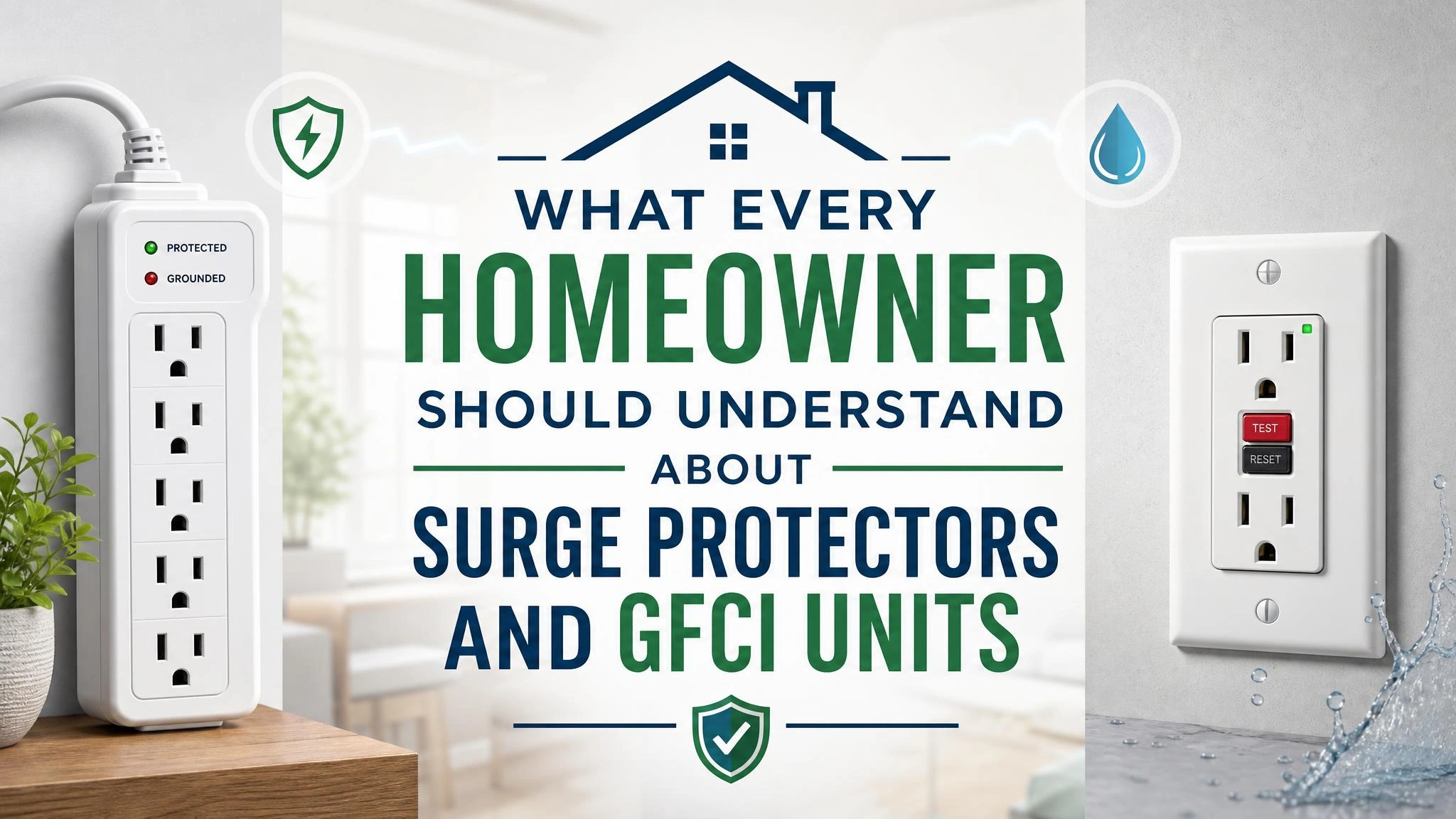
Electrical safety can feel confusing when different devices seem to protect your home in similar ways. Surge protectors and GFCI outlets are both important, but they solve very different problems. A GFCI protects people from electric shock, especially near water. A surge protector protects electronics and appliances from sudden voltage spikes.
This difference matters because one device cannot replace the other.
A GFCI will not stop a power surge from damaging your TV, computer, dishwasher, or home office equipment. A surge protector will not stop a dangerous shock in a bathroom, kitchen, laundry room, garage, or other damp area.
So when comparing surge protector vs GFCI options, the real goal is not choosing one over the other. It is understanding where each device belongs and how both work together to protect your home, your family, and your equipment. Here are the key points every homeowner should know before installing or relying on either one.
Key Takeaways
-
GFCI outlets protect people from dangerous electrical shocks near water sources like kitchens and bathrooms.
-
Surge protectors defend expensive home electronics from sudden voltage spikes and power surges.
-
Homeowners need both devices together to ensure full safety for their family and appliances.
Surge Protector vs GFCI: Key Differences
When you evaluate a surge protector vs GFCI setup, understanding their unique safety functions helps you protect your home effectively. You must treat these units as distinct tools.
How a GFCI Protects Against Shock
A ground fault circuit interrupter continuously monitors electrical current flowing through a circuit. Your household GFCI outlets track the balance between incoming power on the hot wire and outgoing power on the neutral wire. When a person accidentally touches a live wire, electricity leaks through their body toward the ground. The GFCI senses this imbalance immediately.
According to UL 943 standards, a Class A ground fault circuit interrupter trips when it detects a differential leakage current of 4 to 6 milliamps. The minimum threshold that triggers a trip is 4 milliamps.
-
Electricity enters through the hot wire.
-
The GFCI compares incoming current with outgoing current.
-
The device identifies current leakage passing into an unintended path like water or human skin.
-
Power shuts off immediately to prevent electrocution.
Imagine water flowing through a pipe. If the same amount goes in and comes out, everything is fine. Now imagine water leaking out through a crack—that is a problem. A GFCI works the same way with electricity: it monitors flow, and if it senses a leak, it cuts power before anyone gets hurt. A GFCI does not require a ground wire to provide shock protection.
Circuit interrupters like a GFCI help prevent electrocution by shutting off power as soon as they detect a dangerous fault. This fast response makes GFCI outlets essential in high risk areas where water and electricity may come close together. Installing them in kitchens, bathrooms, laundry rooms, garages, and other risk prone spaces helps protect your family from serious shock hazards.
However, standard GFCI outlets do not protect against a sudden voltage surge.
How Surge Protectors Safeguard Devices
While GFCI units defend people, effective surge protection keeps your electronics safe from voltage spikes. Power grid fluctuations, switching heavy appliances, or lightning strikes cause excessive energy to enter your wiring. A dedicated surge strip uses metal oxide varistors to redirect this stray surge current into the ground wire before damaging equipment. Heavy power surge events require proper let-through voltage ratings.
|
Clamping Voltage |
Protection Level |
Best For |
|---|---|---|
|
Excellent |
Computers, servers, high-end audio |
|
|
400V |
Good |
TVs, gaming consoles, home office |
|
500V |
Adequate |
Basic electronics, budget protection |
|
600V+ |
Poor |
Barely better than no protection |
Under UL 1449, a clamping voltage of 330V offers optimal defense for sensitive gear. Implementing robust surge protection shields computers from internal burnouts. However, direct lightning strikes during extreme surge conditions can damage both GFCI outlets and surge protection devices simultaneously.
Understanding this surge protector vs GFCI comparison ensures you place GFCI outlets in wet zones while applying whole-home surge protection across your residence.
Installation Rules for GFCI Outlets and Surge Protection
You must place your safety devices correctly to maximize safety across your home electrical system. Comparing installation rules for a surge protector vs GFCI setup helps you build a solid safety defense. Each device serves a distinct purpose inside your living spaces.
Proper placement keeps your entire house compliant with current building codes while preventing household accidents.
Placing GFCI Outlets in Required Wet Areas
National Electrical Code rules mandate a ground fault circuit interrupter in moisture-heavy zones. You need GFCI outlets in key locations where water creates serious shock risks. Water increases electrical conductivity significantly. Therefore, a GFCI stops current instantly before shock hazards turn lethal. According to NEC 210.8 guidelines, you must provide safety coverage across specific wet zones:
-
Bathrooms: Every outlet requires a GFCI, regardless of distance from water sources. Internal exhaust fan receptacles do not require a GFCI unless manufacturer instructions specify it.
-
Kitchens: You must install GFCI outlets for all countertops, islands, peninsulas, dishwashers, and locations within six feet of sinks. This requirement includes refrigerator, disposal, and microwave outlets.
-
Laundry spaces, shower zones, and damp locations: Installing modern GFCI outlets prevents electrocution hazards completely near plumbing fixtures.
Installing a dedicated GFCI receptacle or breaker keeps your family safe around water. Upgrading older receptacles to GFCI outlets increases overall safety throughout your property. You can easily test each GFCI monthly to confirm active protection. Each GFCI protects human life directly when dangerous current leaks occur.
Positioning Surge Protection for Sensitive Electronics
You need whole-home surge protection at your main electrical panel to block massive external energy spikes entering your building wiring. However, localized point-of-use surge protection helps defend delicate circuit boards on individual gear. You should place point-of-use units right next to sensitive electronics to stop a localized surge before equipment damage occurs. This step prevents financial losses from ruined technology.
| Location | Specific Placement Strategy |
|---|---|
| Home Office | Place units near computers and printers to preserve data and extend device lifespan. |
| Entertainment Center | Connect audio and video components to a single central strip. Never daisy chain multiple strips together. |
| Critical Appliances | Plug expensive televisions directly into localized units to guard against a sudden localized surge. |
Many homeowners ask about plugging a power strip into GFCI outlets. This configuration works safely in any household setting. The GFCI monitors dangerous current leaks, while the strip manages unexpected voltage issues. If an electrical fault occurs, the GFCI trips instantly and cuts power to your strip. When a GFCI shuts off power, connected equipment loses energy safely without causing damage.
Combining proper GFCI outlets with localized surge protection gives your residence complete coverage against a damaging voltage surge. Always ensure a working GFCI keeps you safe while operating appliances near water sources.
Maintenance and Layered Defense Strategy
Testing GFCI Outlets and Replacing Surge Strips
The Consumer Product Safety Commission recommends checking your home safety units monthly. Performing proper testing GFCI outlets routines keeps your family safe from electric shock hazards. You should inspect all GFCI outlets in your kitchen and bathroom.
-
Press the TEST button on your GFCI. You will hear a click, the light turns off, and the RESET button pops out.
-
Press the RESET button firmly until it clicks to restore power.
-
Replace the unit if power does not stop during a test or fails to return.
Most point-of-use strips require replacement every three to five years. Inspect your equipment for burn marks, cracks, or unlit LED lights.
If your neighborhood experiences a major power event, replace your surge protectors immediately. That surge may have wiped out most of their protective capacity, leaving you vulnerable not only to device damage but also to electrical fire risk.
Implementing Whole-Home Protection Solutions
You can install a whole-house unit at your main panel for complete surge protection. This panel-level device safeguards hardwired appliances like HVAC systems. Professional installation costs $300 on average, with typical costs ranging from $70 to $700. A panel unit handles a high external surge before energy reaches your living spaces.
For maximum security, homeowners often combine the two approaches. A whole-house surge protector provides panel-level defense, while point-of-use surge strips add an extra layer for sensitive electronics such as computers or home theater systems. This layered method ensures comprehensive protection across all devices. Combining whole-home surge protection with point-of-use devices protects your property from a sudden voltage surge. You still need a dedicated GFCI near water sources.
Every GFCI prevents serious electrocution risks. Modern GFCI outlets offer reliable defense for your family. Check all GFCI outlets regularly.
You need a GFCI for human safety, while surge protection guards devices against a power surge. A GFCI cannot replace equipment defense, so treat each GFCI separately. Test GFCI outlets and your GFCI monthly. Replace aging strips, inspect every GFCI, and consult an electrician. Maintain all GFCI outlets, one GFCI, another GFCI, and your main GFCI setup.
FAQ
Can a ground fault circuit interrupter replace a surge strip?
No. A GFCI stops shock hazards. Standard GFCI outlets lack surge protection. One GFCI protects skin, while this GFCI cuts power. You still need defense against a surge.
Where should you install GFCI outlets in your home?
Install GFCI outlets in kitchens, bathrooms, and basements. Put GFCI outlets near water. A wall GFCI stops electrocution. Test your GFCI monthly. Each GFCI works if a GFCI resets.
Why do you need both options in a surge protector vs GFCI comparison?
A GFCI preserves safety near water. Strips handle a voltage surge. Plug strips into GFCI outlets safely. Your main GFCI cuts power whenever a GFCI detects a fault.