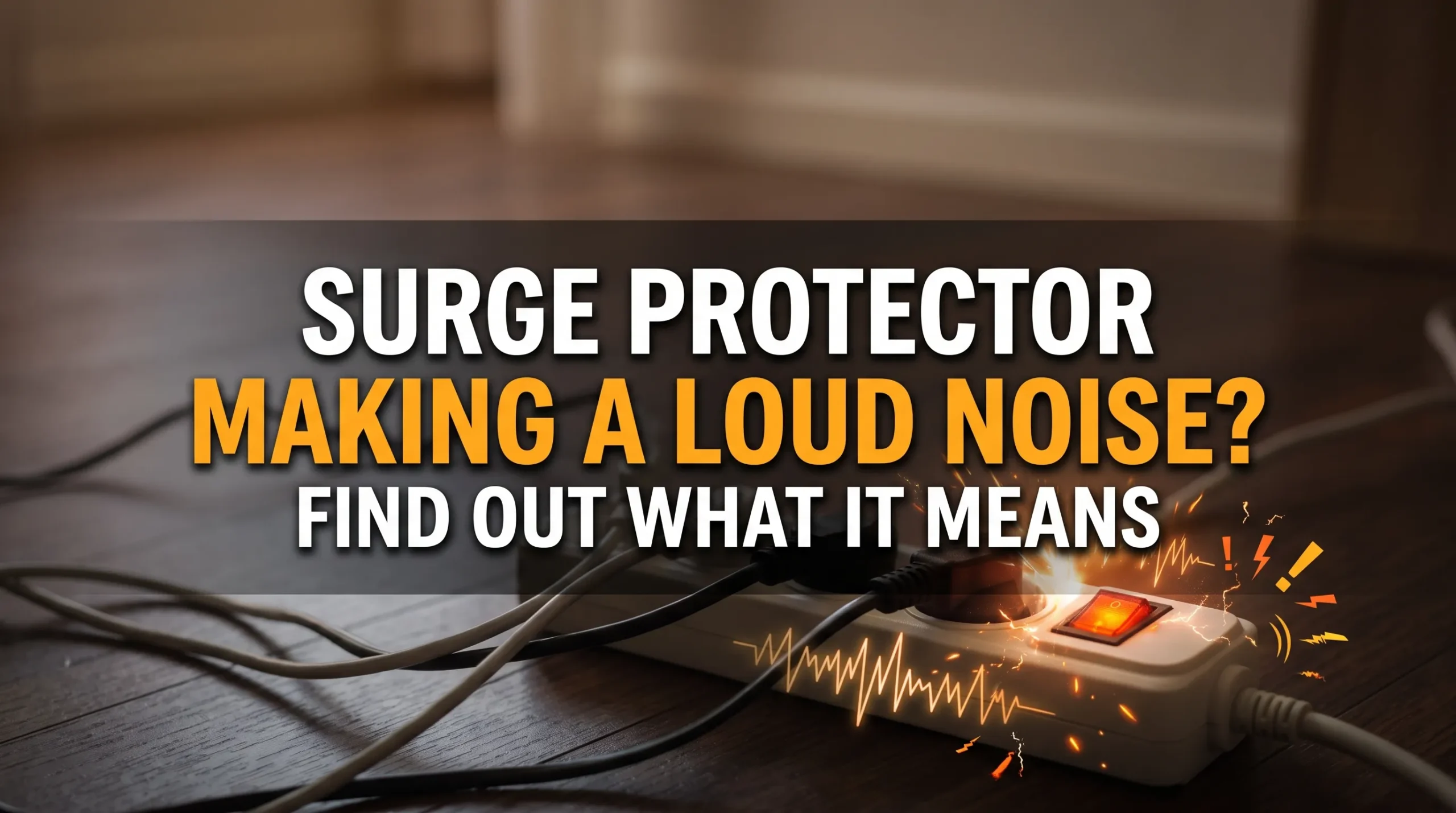
A surge protector making a loud noise should not be ignored or repeatedly switched on to see whether it happens again. New buzzing, crackling, popping, or repeated clicking can involve the protector, a connected device, or the wall outlet. Sound alone cannot identify the fault.
If you see smoke, sparks, or melting, notice a burning smell, or observe signs of excessive heat, stop using the equipment. Do not touch or unplug anything that appears unsafe to handle. For active fire or smoke, move away and contact emergency services. Do not use water on energized electrical equipment.
A basic power strip, surge protector, and battery-backed uninterruptible power supply (UPS) can look similar, but their noises mean different things. A UPS may deliberately beep. A basic power strip should not be auditioning for the percussion section.
Key Highlights
-
New, loud electrical noise warrants stopping use, not repeated power cycling.
-
Crackling, popping, burning smells, discoloration, or signs of overheating call for caution, not opening the enclosure.
-
A UPS may beep to indicate battery operation, low battery, overload, or another condition. Consult the exact model’s manual.
-
If the noise appears to come from the outlet or plug connection, stop using that outlet and arrange an electrician’s assessment.
Before Checking Anything
Keep the investigation observational. You need:
-
A safe distance from suspect equipment.
-
The model number, if accessible without approaching a hazard.
-
The product manual or manufacturer’s support information.
-
A list of connected devices and your existing observations.
You do not need a screwdriver, multimeter, outlet disassembly, or live electrical testing. Do not touch the unit to find out whether it is hot, lean closer to locate a smell, or reproduce the noise for a recording.
The exact model’s manual takes priority over generic advice about alarm patterns, indicator lights, and replacement requirements.
1. Check for Warning Signs Before Approaching
From a safe position, look for smoke, sparking, discoloration, melting, or damage around the strip, plugs, and wall outlet. Note any burning smell without moving closer.
If there are no warning signs and the equipment is safe to handle, switch off connected devices and disconnect the protector by grasping its plug, not pulling its cord. If handling it could be dangerous, do not attempt to unplug it.
A popping sound accompanied by a burning smell ends the troubleshooting process immediately. There is no useful reason to “give it one more try.”
The U.S. Fire Administration’s home-fire prevention guidance provides broader electrical-fire precautions. Once there is active smoke or fire, prioritize getting away and contacting emergency services over saving equipment.
2. Identify the Product and Apparent Source
Use safely accessible labels and what you already observed. Do not reconnect suspect equipment to isolate the sound.
|
Product |
Main purpose |
What to check |
|---|---|---|
|
Basic power strip |
Provides additional outlets within its rated capacity |
Label and instructions; multiple sockets do not establish surge protection |
|
Surge protector |
Limits certain transient overvoltages reaching connected equipment |
Surge-protection labeling and model-specific status indicators |
|
UPS |
Provides temporary battery power, often with surge protection |
Battery-backup labeling, display, and alarm instructions |
NEMA’s surge-protection education explains surge-protective devices and their role. Surge protection is not the same function as battery backup, and neither gives a household circuit additional capacity.
Also consider whether the noise came from a charger, speaker, computer, or nearby outlet. Electronics are surprisingly good ventriloquists. Identifying another possible source is useful, but it does not justify powering everything back up to investigate.
Suggested visual: A labeled diagram comparing a basic strip, a surge protector with protection-status indicators, and a UPS with battery backup. Label controls as representative because designs vary.
3. Match the Sound to the Manual
A beeping battery-backed unit may be doing exactly what it was designed to do: getting your attention.
Possible UPS alarm categories include:
-
Operation on battery power.
-
Low battery.
-
Overload.
-
Battery replacement or another fault.
The sound pattern is not universal. A periodic beep during an outage may be an intentional notification, but its timing and meaning depend on the model. A continuous alarm also needs model-specific interpretation.
Use the display or indicators only if they can be observed safely. Then consult the manual, APC’s audible-alarm guidance, or CyberPower’s support FAQs as appropriate for your equipment.
Some UPS units also click when switching operating states. That possibility does not establish that repeated clicking is harmless, especially if it is new or accompanied by other warning signs. Do not silence an alarm and assume the underlying condition has disappeared.
What Different Sounds May Mean
This table is a triage aid, not a diagnosis. A quiet protector is not automatically healthy, and a faint hum cannot be declared safe from a written description.
|
Observation |
Possible explanation |
Safest next action |
|---|---|---|
|
New loud buzzing or humming |
A component, connected device, or electrical connection may be involved |
Stop using the suspect protector and seek model-specific guidance |
|
Crackling or popping |
Possible arcing or component failure |
Stop use immediately; do not handle equipment showing smoke, heat damage, or melting |
|
Repeated clicking |
A UPS may be changing operating states, but other causes are possible |
Consult the exact model’s manual without repeatedly cycling power |
|
Beeping from a battery-backed unit |
An intentional UPS status or fault alarm |
Match the display and alarm to the manual |
|
Noise apparently at the wall outlet |
A receptacle or wiring problem may be involved |
Stop using that outlet and contact an electrician |
|
No noise, but the protection indicator has changed |
Indicator meanings and protective status vary by product |
Follow the manual; a power light alone does not establish working surge protection |
The Electrical Safety Foundation International’s safety resources address household electrical hazards and warning signs. For UPS-specific sounds, use the manufacturer guidance above rather than treating the table as an alarm decoder.
4. Decide: Manufacturer Support, Replacement, or Electrician?
Contact manufacturer support when a UPS alarm needs interpretation or the manual does not explain a status change. Provide the model number, existing observations, and connected-device list. Do not recreate a fault to collect more evidence.
Replace a damaged or malfunctioning surge protector rather than opening or modifying it. Check the model against CPSC recall notices, especially if it shows unexpected heating or damage. If recalled, follow the notice’s specific remedy and handling instructions.
Call an electrician if the sound appears associated with the receptacle or plug connection, the outlet is discolored, a plug no longer fits securely, or breakers trip repeatedly. Do not repeatedly reset a breaker to keep the equipment running.
OSHA’s electrical-safety guidance addresses hazards including shock and fire. OSHA is a workplace authority, not a substitute for a residential electrician’s assessment. Replacing a strip cannot repair a defective receptacle or wiring connection.
Keep the Replacement From Inheriting the Problem
Tip: Never connect one power strip or surge protector to another.
Daisy-chaining adds connections and can create an overloaded arrangement. Follow the protector’s rating and each connected appliance manufacturer’s instructions. Some high-power appliances require direct wall connection.
A surge protector does not increase circuit capacity. A higher joule rating concerns surge-energy handling, not permission to connect more load.
Tip: A power light and a protection-status light may mean different things. Check the manual.
Keep the unit dry, uncovered, and protected from physical damage. Do not pinch cords under furniture or route them where they can be crushed or damaged. NFPA’s household electrical-safety guidance provides related precautions for cords, outlets, and electrical equipment.
When shopping, choose a product suitable for the intended location and use, with appropriate certification from a recognized testing organization. UL Solutions’ surge-protective-device testing and certification information explains its evaluation services. Certification does not eliminate the need to follow ratings and instructions or address unsafe wiring.
Final Thoughts
U.S. readers can report a suspected hazardous consumer product through SaferProducts.gov. Keep the model information and existing photos if available, but do not approach or reconnect unsafe equipment to document it. Reporting is not an emergency-response service.
A noisy accessory does not need an encore.
FAQ
Is a buzzing surge protector dangerous?
The sound alone cannot establish safety. New or loud buzzing warrants stopping use and seeking model-specific guidance. Burning smells, crackling, discoloration, smoke, or melting make the situation more urgent. Do not touch equipment that appears unsafe.
Can I keep using it if the outlets still work?
Working outlets do not prove that surge protection remains functional. Some products can continue supplying power after their protective function is compromised. Follow the manual’s indicator and replacement instructions rather than using connected devices as a test.
Why is it beeping after a power outage?
It may be a UPS reporting battery operation, low battery, or another condition. Confirm the product type and consult its manual. A beep after an outage does not, by itself, prove that surge protection has failed.
Can I open it and fix the noise?
No. Do not open or modify a suspect protector or UPS. Disconnecting a UPS from the wall does not remove its internal battery energy. Use manufacturer support, replacement, or qualified service as appropriate.
How often should I replace a surge protector?
There is no universal replacement interval. Follow the manufacturer’s guidance, protection-status indicators, recall notices, and evidence of damage or malfunction. Do not assume every protector must be replaced after a fixed number of years.
Should I try it in another outlet?
Do not move and re-energize a suspect unit as a diagnostic experiment, especially after crackling, burning smells, signs of overheating, or visible damage. If the original outlet may be involved, stop using it and have an electrician assess it.